
Where the Panj Darya Met the Gardens of Shiraz
The Historic Connection Between Panjab and Persia, Rooted in the Sacred Tradition of the Sikhs
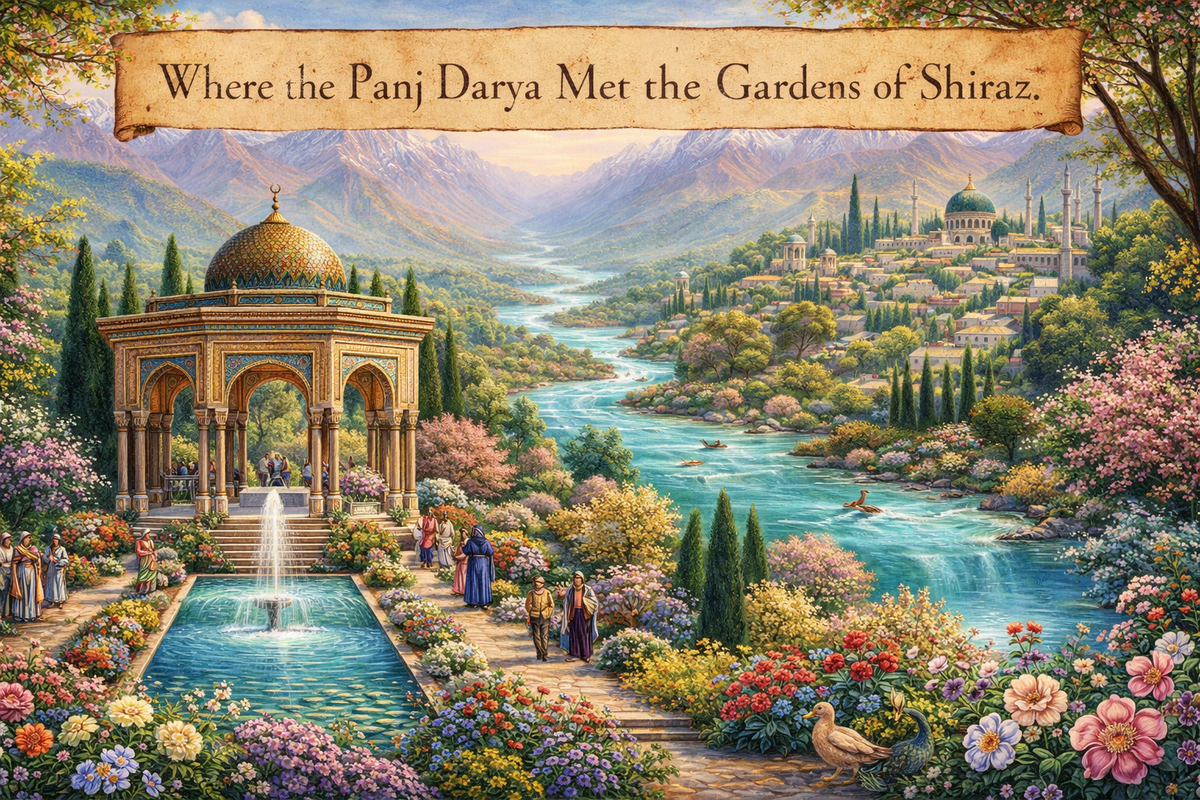
A Note on Method: This article takes the Sikh sacred tradition, Guru Granth Sahib Ji, the compositions of the Gurus, and the Sikh historical encounter with Persianate civilisation as its primary analytical lens. The Persian connection to Panjab is examined as it appears most vividly and enduringly: in the language of devotion, the architecture of the sacred, and the spiritual inheritance of a people.
Introduction: The Persian Soul of a Panjabi Word
There is a word that sits at the very heart of Panjabi identity a word so deeply embedded in the land's name that most who speak it daily have ceased to notice its Persian soul. Panj five. Ab water. Five rivers. The land of five waters. But ab is not Panjabi. It is Persian. And in that etymological intimacy lies the entire argument of this article, Panjab and Persia are not merely neighbours across a cultural map. They are, in the most literal sense, named from the same breath.
For over two millennia from the age of the Achaemenid Empire to the twilight of the Mughal successor states the lands watered by the Jhelum, Chenab, Ravi, Beas, and Sutlej absorbed Persian language, aesthetics, spirituality, and power. But nowhere did this absorption reach greater depth, or achieve more permanent expression, than in the sacred literature and living traditions of the Sikhs. Guru Granth Sahib, the eternal living Guru of the Sikhs, is composed in multiple languages and Persian is among them. The Zafarnama of Guru Gobind Singh is written in Persian. The Sikh spiritual vocabulary is saturated with Persian mystical thought.
This essay begins where that depth is greatest, in the Sikh tradition. From there it reaches backward to the Achaemenid origins of the connection, outward to the Sufi orders that formed the spiritual bridge, and forward to the architecture, language, and living culture of a Panjab still breathing Persian air.
I. The Guru Granth Sahib and the Persian World
Persian as a Language of the Sacred
The Guru Granth Sahib compiled by Guru Arjan Dev Ji in 1604 and given its final form by Guru Gobind Singh Ji in 1708 is among the most linguistically diverse sacred scriptures in the world. Its 1,430 angs (pages) contain compositions in Panjabi, Braj Bhasha, Sanskrit, Arabic, and Persian. The inclusion of Persian is not incidental. It reflects the reality of a Panjab in which Persian was not merely a court language but a living spiritual idiom the tongue of the Sufi masters whose influence runs as a golden thread through the Sikh tradition.
The Guru Granth Sahib includes compositions of the Bhagats, the saint-poets whose verses Guru Arjan Dev Ji incorporated alongside those of the Sikh Gurus and among these, figures like Sheikh Farid (Baba Farid Ganj Shakar, the great Sufi of Pakpattan) composed in a Panjabi that was itself deeply Persianised, rich with Persian vocabulary and metaphysical concepts drawn directly from the Sufi tradition of Iran.
"Farida, rati rati sab jag maya (Farid, bit by bit, the whole world is illusion)." The Panjabi metre and Persian metaphysics are inseparable in this verse, which rests in the Guru Granth Sahib as scripture eternal.
The concept of divine love ishq as the supreme path to the Divine is a Persian Sufi inheritance that finds its fullest Panjabi expression in Sikh spirituality. The Guru Granth Sahib uses the Persian-derived word prem interchangeably with ishq in its discourse on divine devotion. The metaphysics of yearning virah (separation) and milap (union) mirror precisely the Persian Sufi categories of firaq and wisal. The Guru Granth Sahib did not borrow these ideas uncritically, it transformed them, but it transformed them from a deep knowledge of their Persian origin.
The Zafarnama: Guru Gobind Singh's Persian Masterpiece
Perhaps the single most dramatic demonstration of the Sikh-Persian relationship is the Zafarnama the Epistle of Victory composed by Guru Gobind Singh Ji in 1705 and addressed to the Mughal Emperor Aurangzeb. The Guru wrote it entirely in Persian. This was not compulsion. Guru Gobind Singh was a polyglot scholar who composed in Braj Bhasha, Panjabi, Sanskrit, and Persian. He chose Persian for his most charged political and moral statement because Persian was the language of civilisational authority of gravitas, of the literary tradition against which any serious claim of justice had to measure itself.
"Tu ra Khuda-e pak nazir ast (The Pure God is watching you)." These opening words of the Zafarnama a Sikh Guru addressing a Mughal emperor in Persian represent perhaps the fullest expression of the civilisational entanglement of Panjab and Iran.
The Zafarnama draws on the Persian martial-poetic tradition, the ghazal's emotional intensity, the qasida's rhetorical power, the masnavi's narrative flow. Guru Gobind Singh employs Persian literary conventions hyperbole, apostrophe, the invocation of God as witness to prosecute a moral case against imperial tyranny. That a Sikh Guru writing to a Mughal emperor in Persian should produce one of the most powerful documents of human rights and divine justice in the Sikh canon says everything about how deeply Persian had become a shared civilisational tongue across Panjab's religious traditions.
Guru Nanak and the Sufi Persian World
Guru Nanak Dev Ji's encounters with Sufi masters are documented in the Janam Sakhis the traditional hagiographies of the first Guru and reflect a deep engagement with the Persian mystical tradition. His documented familiarity with the poetry and thought of Sufi masters from the Chishti lineage situates Guru Nanak in the Persianate spiritual world of fifteenth-century Panjab.
Guru Nanak's own compositional language absorbs Persian vocabulary at the level of primary spiritual concepts: rab(Lord, from Arabic via Persian), noor (divine light), fana (spiritual annihilation in the Divine) these appear in his compositions as structural terms, not ornamental borrowings. They describe the inner architecture of the spiritual path. That Guru Nanak employed them signals his engagement with, and transformation of, the Persian Sufi tradition into his own distinct revelation.
The Japji Sahib, the foundational composition that opens the Guru Granth Sahib and that every Sikh recites at dawn contains vocabulary and metaphysical frameworks that can only be fully understood in the light of the Persian-Sufi discourse Guru Nanak was engaging, affirming, and surpassing. This is not reduction, it is recognition of the remarkable civilisational synthesis the Sikh tradition achieved.
II. The Achaemenid Inheritance: When Persia First Touched the Five Rivers
Long before any Mughal emperor looked west toward Khorasan for aesthetic inspiration, Panjab's encounter with the Iranian world had already begun in the grand administrative machinery of the Persian Achaemenid Empire. When Darius the Great extended his dominion to the Indus in the late sixth century BCE, the satrapy of Hindush encompassing western Panjab and Sindh became a province of the mightiest empire the ancient world had yet known.
Persian imperial culture arrived not through violence alone but through the extraordinarily effective instruments of bureaucracy and commerce. Aramaic, the administrative lingua franca of the Achaemenid Empire, left its structural imprint on early Panjabi and proto-Indic scripts. The Kharosthi script used to write Gandhari Prakrit, the sacred language of early Buddhist texts discovered across Panjab and Afghanistan shows unmistakable structural debts to Aramaic, the scribal tongue of Persian imperial officers.
The Gandharan civilisation that flourished in northwestern Panjab stands as one of history's most extraordinary cultural syntheses Greek, Persian, and Indic forms fused into a Buddhist art that shaped the image of the Buddha for all of East and Southeast Asia. Less remarked upon is the Persian contribution: the courtly aesthetic, the flame-shaped halos, the regal posture that echoes directly from Achaemenid royal iconography found at Persepolis and Susa. Iran did not merely administer the five rivers. It taught them, in part, to imagine divinity.
III. The Sufi Bridge: Iran's Most Lasting Spiritual Gift
If the Achaemenid period represents the first political contact and the Mughal period its most spectacular cultural flowering, the Sufi orders constitute the deep spiritual root of the Panjab-Persia connection and the channel through which it most directly shaped the Sikh tradition. The great Sufi orders that transformed Panjabi spiritual life the Chishti, the Qadiri, the Suhrawardi all originated or were profoundly shaped in Iran before travelling east.
The founder of the Chishti order took his name from Chisht, near Herat in what is today Afghanistan. The Suhrawardi order was founded by scholars embedded in Persian intellectual culture. What these orders brought to Panjab was not merely a religion it was an entire aesthetic and philosophical world, the concept of divine love (ishq) as the supreme spiritual force; the image of the tavern (maikhanah) as a metaphor for spiritual ecstasy; the beloved's face as a mirror of Divine beauty.
Baba Farid Ganj Shakar whose verses are enshrined in the Guru Granth Sahib was a Chishti Sufi. His spiritual lineage ran directly from Panjab through Delhi to the heartlands of Persian Sufi thought. That Guru Arjan Dev Ji placed his compositions alongside those of the Sikh Gurus in the Guru Granth Sahib is the definitive Sikh acknowledgement of the Persian-Sufi inheritance as a sacred resource.
Data Ganj Bakhsh Ali Hujwiri whose dargah in Lahore remains one of the great shrines of Panjab, was from Ghazni and steeped in Persian Sufi learning. His Kashf al-Mahjub, written in Persian, is the oldest Persian treatise on Sufism. That his tomb is visited by Sikhs, Hindus, and Muslims alike to this day speaks to how thoroughly the Persian Sufi world became part of Panjabi spiritual identity across all its traditions.
IV. Lahore: The Persian City of the East
To walk through the old quarters of Lahore through the Wazir Khan Mosque, past the Shahi Qila, along the residual grandeur of the Shalimar Gardens is to walk through a city built in the Persian aesthetic imagination. Every element of Mughal Lahore speaks the visual language of Isfahan and Shiraz, the geometric tilework in turquoise and cobalt, the formal charbagh (four-quartered garden) plan echoing the Persian paradise garden, the calligraphic bands of Persian verse running across every threshold and arch.
The Shalimar Gardens of Lahore, commissioned by Shah Jahan in 1641, are modelled directly on the Achaemenid and Safavid Persian garden tradition. The very word paradise in English comes from the Old Iranian pairidaeza a walled garden of flowing water and fragrant bloom and nowhere in South Asia is that paradise more literally enacted than in the Shalimar, a short distance from the Golden Temple at Amritsar.
The Golden Temple itself Harmandir Sahib though distinctly Sikh in its spiritual character and theological symbolism, participates in the broader aesthetic vocabulary of Persianate architecture. The marble inlay work, the formal reflecting pool, and the decorative traditions of the surrounding complex all reflect an aesthetic environment shaped by centuries of Persian visual culture in Panjab.
The architecture is unique, and in embedded with sikh principles, with 4 doors inviting all, the way the stairs are laid to walk down for blessings and walk up high with grace. Making it the true reflection of Sikh Principles
V. Persian in the Panjabi Language: The Vocabulary of the Soul
The depth of Persian's penetration into Panjabi can be measured by the impossibility of extracting it cleanly. The borrowed vocabulary constitutes the primary lexicon of inner life, of spiritual experience, of love and longing. Every time a Panjabi speaker says dil for heart, zindagi for life, asman for sky, yar for friend, khushi for happiness, noor for light, or ishq for love they are speaking Persian.
The entire apparatus of Panjabi mystical poetry the genre that produced Bulleh Shah, Shah Hussain, Waris Shah, and Sultan Bahu employs Persian poetic forms the ghazal, the kafi (mirroring the Persian lyric), the masnavi narrative. The metaphors are Persian the bulbul (nightingale) and the gul (rose); the maikhanah (tavern) and the saqi (wine-bearer). The Sufi concepts are Persian fana (annihilation in the Divine), baqa (subsistence in God), marifat (mystical knowledge).
Allama Iqbal the Panjabi philosopher-poet chose to write his most ambitious works in Persian. His Asrar-e-Khudi, Rumuz-e-Bekhudi, and the magnificent Javid Nama are all in Persian. Iqbal believed that Persian was the language through which the civilisational inheritance and the South Asian spiritual heritage could best speak to each other. He named Rumi born in Khorasan as his spiritual guide.
VI. Trade, the Khorasan Highway, and Material Culture
Beyond language and spirit, the Panjab-Persia connection was sustained by commerce. The ancient Khorasan Highway the overland artery connecting Central Asia, Iran, Afghanistan, and Panjab was one of history's great engines of cultural diffusion. Caravans carrying silk, saffron, horses, carpets, dried fruits, metalwork, and manuscripts moved in both directions for centuries, carrying with them artisans, scholars, musicians, Sufi teachers, and refugees.
Panjabi textile traditions show persistent Persian influence the phulkari embroidery's stylised floral vocabulary echoes Persian garden carpet designs. The Kashmiri shawl is built on the buta motif (the paisley), derived from the Persian cypress tree and the Zoroastrian symbol of the flame. The word buta itself is Persian. The Panjabi cavalry tradition which would eventually power the Sikh Khalsa armies under Maharaja Ranjit Singh was built substantially on Iranian and Central Asian horseflesh and horsemanship traditions.
VII. The Living Inheritance
The historian's danger is to speak only in the past tense. Contemporary Panjabi, spoken by over 120 million people worldwide, retains thousands of Persian loanwords so completely naturalised that their speakers do not perceive them as foreign. The devotional music of the Panjabi shrines and Sikh gurdwaras still performs Persian and Persian-inflected verse. The Sikh tradition of kirtan contains melodic structures that trace, at least partly, to the Persian and Central Asian musical systems that saturated Persian Panjab.
When a Sikh recites Guru Nanak's Japji Sahib at dawn, they speak in a language whose spiritual vocabulary is partly Persian, whose mystical framework was formed in dialogue with the Sufi world of Iran, and whose beauty is inseparable from that inheritance. The Guru Granth Sahib stands as the most enduring monument to that meeting a scripture that holds within it the Persian Sufi tradition, the Arabic Islamic discourse, the Sanskrit Hindu inheritance, and the original revelation of Guru Nanak all transformed, but none forgotten.
"Panj" five. "Ab" water. Persian, breathing through every syllable of a Panjabi identity. An intimacy so old it has become nature itself.
In the end, what the history of Panjab and Persia offers us is not merely an academic lesson in cultural diffusion. It offers a testament to what happens when two great civilisations meet not only in war and empire but in poetry and prayer, in trade and artisanship, in the slow and beautiful work of building a shared aesthetic and spiritual world.
This Vaisakhi
References & Further Reading
Primary Sources
- Guru Granth Sahib. Compiled by Guru Arjan Dev Ji (1604); final recension by Guru Gobind Singh Ji (1708). Shromani Gurdwara Parbandhak Committee, Amritsar.
- Guru Gobind Singh Ji. Zafarnama (c.1705). In: Dasam Granth. See also: Fenech, Louis E. The Sikh Zafar-namah of Guru Gobind Singh. Oxford University Press, 2013.
- Ali Hujwiri (Data Ganj Bakhsh). Kashf al-Mahjub (c.1063 CE). Trans. R.A. Nicholson. Luzac & Co., 1911.
- Darius I. Behistun Inscription (c.515 BCE). Trans. and ed. Rudiger Schmitt. Corpus Inscriptionum Iranicarum, 1991.
- Allama Iqbal, Muhammad. Asrar-e-Khudi (1915) and Javid Nama (1932). Iqbal Academy Pakistan, Lahore.
Historical & Scholarly Works
- Alam, Muzaffar. The Languages of Political Islam: India 1200–1800. University of Chicago Press, 2004.
- Eaton, Richard M. India in the Persianate Age, 1000–1765. University of California Press, 2019.
- Eaton, Richard M. The Rise of Islam and the Bengal Frontier, 1204–1760. University of California Press, 1993.
- Schimmel, Annemarie. Mystical Dimensions of Islam. University of North Carolina Press, 1975.
- Schimmel, Annemarie. Pain and Grace: A Study of Two Mystical Writers of Eighteenth-Century Muslim India. Brill, 1976.
- Shackle, Christopher. "Persian Poetry and Quranic Exegesis in the Sikh Tradition." Bulletin of the School of Oriental and African Studies, vol. 43, no. 2 (1980), pp. 323–345.
- Fenech, Louis E. The Sikh Zafar-namah of Guru Gobind Singh: A Discursive Blade in the Heart of the Mughal Empire. Oxford University Press, 2013.
- McLeod, W.H. Guru Nanak and the Sikh Religion. Oxford University Press, 1968.
- Singh, Pashaura. The Guru Granth Sahib: Canon, Meaning and Authority. Oxford University Press, 2000.
- Mandair, Arvind-Pal Singh. Religion and the Specter of the West: Sikhism, India, Postcoloniality, and the Politics of Translation. Columbia University Press, 2009.
- Shackle, Christopher. A Guru Nanak Glossary. SOAS, 1981.
Architecture, Material Culture & Language
- Koch, Ebba. Mughal Architecture: An Outline of Its History and Development (1526–1858). Prestel, 1991.
- Wescoat, James L. & Wolschke-Bulmahn, Joachim (eds.). Mughal Gardens: Sources, Places, Representations and Prospects. Dumbarton Oaks, 1996.
- Platts, John T. A Dictionary of Urdu, Classical Hindi, and English. W.H. Allen & Co., 1884.
Achaemenid-Indus Connection
- Briant, Pierre. From Cyrus to Alexander: A History of the Persian Empire. Trans. Peter T. Daniels. Eisenbrauns, 2002.
- Salomon, Richard. "New Evidence for a Gandhari Origin of the Arapacana Syllabary." Journal of the American Oriental Society, 110.2 (1990).
- Falk, Harry. Asokan Sites and Artefacts. Philipp von Zabern, 2006.
This article is dedicated to the memory of Annemarie Schimmel (1922–2003), whose lifelong devotion to the Persian and South Asian mystical traditions illuminated the rivers that run between them.
© Samar Singh Kohli | Histories of the East



Comments ()