
The Vending Machine Patriot
A psychological, historical, and thoroughly sarcastic analysis of public behaviour of Kapoor who became everything to everyone and nothing at all.
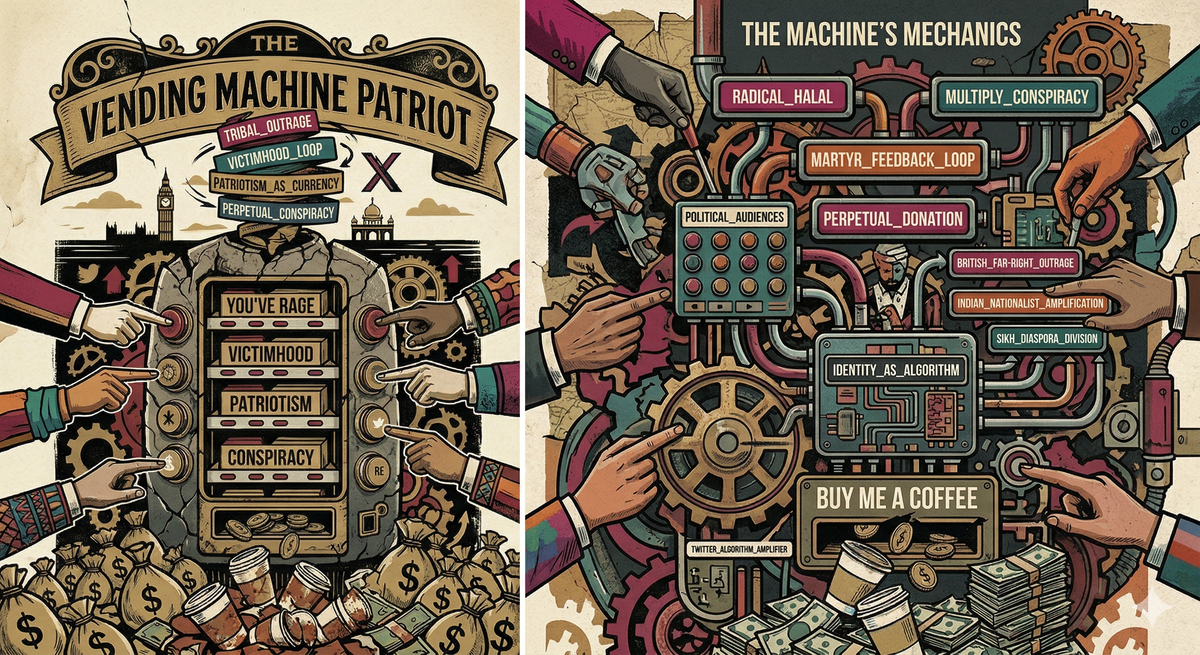
A vending machine doesn't care who presses its buttons. Press A3, you get outrage. Press B7, you get martyrdom. Press C2, you get patriotism extra strong, with Indian nationalist flavouring. The machine is always on. The machine is always hungry. And the machine always has a donation link in the bio.
The Bio, The Brand, The Bottom Line
Let us begin, as all good investigations do, at the beginning. His X bio reads: "OWNER OF RANGREZ NON HALAL INDIAN RESTAURANT. FREEDOM IS NOT FREE." And then, sitting quietly beneath that stirring declaration of liberty a link to his Buy Me a Coffee page.
Freedom is not free. Correct. Apparently it costs a flat white and a brownie, payable directly to Harman Singh Kapoor.
This is not a small detail. It is, in fact, the entire business model in seventeen words and one hyperlink. Understand the bio and you understand the man. He is not a community leader, not a political thinker, not a religious figure in any meaningful sense. He is a content operation one that has discovered, with impressive efficiency, that Britain's outrage economy will pay very generously if you push the right buttons in the right order.
The buttons, in ascending order of profitability, Sikh identity. British patriotism. Anti-Islam rhetoric. Pakistani gangs. Khalistani conspiracies. Victimhood. Martyrdom. And, for the Indian nationalist audience tuning in from abroad a warm, familiar anti-Sikh-self-determination flavour that makes OpIndia practically purr with satisfaction.
The machine serves everyone. The machine profits from all of them. And the machine this is the genius part never has to be consistent, because each audience only ever sees the flavour they ordered.
The Asylum Seeker Who Hates Asylum Seekers
Here is the foundational contradiction, the one from which all others flow like tributaries from a polluted spring.
Stirring. Genuinely. A man flees a radicalised country, arrives in Britain, and builds a life. The system extended its protection. The system gave him everything. A beautiful story right up until the same story ends with "And immigrants who came in here to change this beautiful country can fuck off."
The same man who arrived as an asylum seeker. The same man who was given safety by a country that asks few questions when you're fleeing violence. The same man who owes his entire post-Afghanistan existence to British pluralism, that man has appointed himself gatekeeper of who deserves to be here.
In psychology, this is called in-group projection via disassociation: once you've crossed the threshold, you perform violent rejection of those still outside it, as a way of cementing your own belonging. The louder the rejection, the more desperate the underlying insecurity. Henri Tajfel and John Turner's social identity theory documented this mechanism decades ago. Kapoor is not innovating. He is simply doing it on X with better reach.
In the same post, he declared: "This is a Christian land." He is, for the record, a Sikh. He arrived from Afghanistan. He is making this declaration about Christianity. In a country where he arrived asking for asylum. The contradictions do not embarrass him. They are, as we shall see, entirely by design.
Psychological note: Research on motivated reasoning (Kunda, 1990) shows that the mind will construct whatever justification is needed to reach a pre-determined conclusion. In Kapoor's case, the conclusion appears to be: "I belong here and certain others do not." The reasoning Christian land, British values, anti-Islamisation shifts freely to serve that conclusion. The conclusion never shifts.
Too Extreme For Tommy Robinson
(A Sentence That Should Come With a Warning Label)
There is a sentence in the public record about Harman Singh Kapoor that demands to be read very slowly, because it contains multitudes.
Baaz News, reporting on the 2024 UK far-right riots, described him as Tommy Robinson's "newest standout cheerleader." He marched. He posted. He performed loyalty to the far-right with the enthusiasm of a man who has finally found his people.
And then Tommy Robinson's people threw him out.
The publicly documented reason? According to statements made by Robinson himself, Kapoor allegedly posted images of Robinson's then-15-year-old son online while Robinson was in prison conduct Robinson stated "scared his son badly." Robinson's team also cited him being "booted from his organisation for insulting Sikh communities."
To be clear: Tommy Robinson the man with a criminal conviction record, the co-founder of the English Defence League drew a line. And Harman Singh Kapoor was on the wrong side of it. This is not editorialising. This is a documented sequence of public events, stated by the parties involved, on publicly accessible platforms.
The far-right, meanwhile, was never going to treat him as an equal. Baaz News noted it plainly, he "received a torrent of racism online despite his clear allegiances to Robinson." The movement he championed directed hate at him. He apparently did not notice, or did not mind, until they made the rejection formal.
Neuroscience has a name for what happens when someone builds their identity entirely around tribal loyalty and that tribe rejects them: identity-threat response. The typical coping mechanism is escalation louder claims, more extreme positions, a new audience. Watch for this pattern in everything that follows.
His response to being expelled? He announced he was pivoting to full-time activism. The machine doesn't break down. It finds a new socket to plug into.
The Restaurant: A Stage, Not a Kitchen
Let us be scrupulously fair here, because fairness is the armour that makes the rest of this piece unassailable.
Harman Singh Kapoor's decision not to serve halal meat at Rangrez was a legal business decision. Many Sikhs cite the tradition of jhatka meat and object to halal slaughter on religious grounds. That is his right, entirely, without qualification.
Now observe what he chose to do with that right.
On the morning of March 14, 2026, he used social media to call a "Non Halal meetup" at the restaurant, explicitly urging supporters to arrive at 2pm and to bring recording equipment "to help us record any troublemakers." He did not simply open his restaurant and serve lunch. He issued a rally call, requested cameras, and waited for the conflict to arrive.
Footage shared widely online showed Kapoor confronting the crowd outside, shouting "Kill me" as police attempted to de-escalate the situation. He was arrested and subsequently released without charge. His immediate post-arrest statement: "All I did was protect my family, yet I was the one arrested. Instead of protecting us, the police targeted my religion my Sikh faith and my beliefs."
A week before the incident, he had posted: "Inbreds are not my customers" referring, in context, to Muslim patrons objecting to his non-halal policy. In an earlier post, halal slaughter "promotes terrorism."
This is not a man quietly running a restaurant according to his faith. This is a man who understood with sophisticated media literacy that conflict is content, that content is currency, and that a camera-ready confrontation outside a curry house in Hammersmith was worth more in impressions than sixteen years of quietly serving butter chicken.
The science of why this works is well established. Joseph LeDoux's neuroscience research shows threat-based narratives activate the amygdala and encode more deeply in memory than neutral information. Studies on moral outrage show that content framed as an attack on identity triggers both protective rage and dopaminergic reward meaning his followers feel righteous and pleasured simultaneously when consuming it. The algorithm rewards exactly this. The donation link sits in the bio, patient as ever.
And then, with perfect timing, he announced the restaurant was closing. Then said it wasn't. Then it was. This is not inconsistency. This is serial cliffhangers the content creator's most reliable tool.
The British Patriot With Very Foreign Backers
Here is where the vending machine metaphor becomes genuinely illuminating.
Harman Singh Kapoor presents himself as a fiercely British patriot. But observe who is pressing his buttons from abroad.
OpIndia described by Reporters Without Borders as "closely aligned with the supremacist Hindu nationalist ideology Hindutva" amplified his story repeatedly, framing him as a heroic Sikh standing against Islamists and Khalistanis. Retired Indian Foreign Service officers praised him on X. Indian nationalist media outlets ran his arrest story with breathless sympathy.
Baaz News identified the broader pattern with precision, "Indian accounts have been amplifying and pushing anti-Sikh rhetoric online, using their IT Cells to feed impressions and clicks to far-right accounts." Kapoor's role in that ecosystem, they noted, is "no secret." He is described plainly as "a known Indian nationalist online agitator who previously worked to target Sikh sentiments."
The Institute for Strategic Dialogue documented the strategic alliance between the Indian nationalist ecosystem and the British far-right, noting that the relationship is built on a shared enemy Islam rather than any shared values. As King's College professor Christophe Jaffrelot observed, "it might seem like a strange alliance but it is strategic."
So, a man who calls himself a British patriot is the beloved figure of Indian nationalist media. A man who claims to speak for Sikhs is amplified by outlets that, by the analysis of many Sikh journalists, work against Sikh interests. A man who wraps himself in the Union Jack is most loudly cheered by people sitting in Delhi.
This is not patriotism. In the language of 20th century political history, this is what scholars of émigré influence operations called a "soft asset" a figure in a foreign country who sincerely believes he is a patriot, while his content serves the interests of a foreign ideological project. No conspiracy required. Just alignment of incentives and a well-functioning vending machine.
Note: OpIndia was found by RSF to have published at least 314 articles specifically targeting journalists, with coordinated harassment campaigns following many of them. This is the outlet that treats Harman Singh Kapoor as a hero. The company a man keeps is always instructive.
The Contradiction Engine: A Public Record
The following is not editorial. It is a documented chronology of his public positions, placed side by side. The reader may draw their own conclusions. The reader will find it very easy to do so.
What He Said Vs What Also Happened
- "I came to the UK as an asylum seeker… We didn't come to change Britain."Follows with: "immigrants who came in here to change this beautiful country can fuck off."
- Presents himself as a devout Sikh defending his faith, Booted from Tommy Robinson's organisation for allegedly insulting Sikh communities
- Claims Britain is "a Christian land" and Is not Christian. Is not British-born. Arrived from Afghanistan as an asylum seeker
- Positions himself as a proud British patriot, Primary amplification comes from Indian nationalist media and retired Indian Foreign Service officers
- Presents as defender of Sikh identity, Described by Baaz News as "a known Indian nationalist online agitator who previously worked to target Sikh sentiments"
- Announced Rangrez restaurant was closing due to harassment, Then said it was staying open due to local support. Then closed it. Then discussed reopening
- Shared a video about Israel's drones in Gaza captioned "See the Miracle", Community notes on X flagged the video as being from Jordan in 2020, showing people faking deaths during COVID curfew. Unrelated to Israel or Gaza entirely
- Tommy Robinson's standout cheerleader, marching and posting alongside him, Expelled by Robinson's team. The far-right still directed racism at him throughout his period of allegiance
All entries above sourced from documented public posts, X community notes, Baaz News, Reform Party UK Exposed, and statements by parties directly involved.
The "Sikh" Label: Costume or Conviction?
This section requires the most care, and is offered with the most precision.
Questions of religious authenticity are deeply personal. We make no claim about what anyone believes in private, or what their relationship with Waheguru is, or isn't. That is not our territory and never will be.
But when a person makes their religious identity the primary justification and branding vehicle for their entire public persona when the turban, the surname, and the kirpan are the opening arguments in every public confrontation then the gap between claimed identity and observable behaviour becomes a matter of legitimate public interest.
Sikhi, as a tradition, is built on Sewa (selfless service), Chardi Kala (eternal optimism in the face of adversity), and the radical equality of all people before Waheguru. The Guru Granth Sahib speaks to the dignity of every human being regardless of faith. This is not debatable within Sikh scholarship. It is foundational.
Now read his documented public language. "Inbreds are not my customers." Halal slaughter "promotes terrorism." Pakistani and Bangladeshi men are "brainwashing girls."
These are not the words of a man practising his faith. They are the words of a man using his faith as costume, as shield, as content hook. What he actually practises is what psychologists of religion call identity-label instrumentalism: the deployment of religious or ethnic signifiers to generate social capital, without meaningful engagement with the tradition's ethical framework.
The Sikh community itself has noticed. Baaz News, the Sikh Press Association, and Sikh journalists across the diaspora have consistently distinguished between Sikh identity and Kapoor's politics. That distinction is not a political attack on him. It is the community he claims to represent, declining to be represented by him.
The Machine Never Breaks Down
Here is the final and most important thing to understand about Harman Singh Kapoor.
He is not a particularly sophisticated thinker. He is not a sincere religious figure. He is not a coherent patriot. He is not a community leader in any tradition that would recognise itself in his behaviour.
What he is and this is offered without malice, purely as observation is a man who discovered, probably through intuition rather than strategy, that the social media reward system pays maximum returns for maximum outrage, maximum victimhood, and maximum tribal certainty. And that religious and national identity-labelling makes all of it more profitable, because it grants the performer automatic in-group trust without requiring them to actually earn it.
He is the vending machine. The British far-right pressed a button and got an anti-Islam ally. Indian nationalist media pressed a button and got an anti-Khalistan soldier. His followers press a button and get a martyr who confirms everything they already believe. Everybody walks away satisfied. The machine keeps 20 percent.
What makes him genuinely worth examining is not the man himself, he is, ultimately, quite ordinary in his mechanics but the ecosystem that sustains him. The Indian nationalist IT cells amplifying his content. The OpIndia machine framing him as a hero. The far-right networks that used him and dropped him and directed racism at him throughout. The algorithm that rewards fear and rage more generously than truth and complexity.
He is a symptom, not a cause. He is what happens when a reward system is built around outrage, and a person figures out that they can be the outrage factory. The only missing ingredient, in the entire operation, is accuracy.
He shared a video he claimed showed the power of Israeli drones. Community notes established it was footage from Jordan in 2020, showing people faking deaths to evade a COVID curfew. He called Muslims "inbreds" while presenting himself as a man of God. He was expelled from the far-right for conduct the far-right found unacceptable. He declared Britain a Christian land while being a Sikh immigrant from Afghanistan.
And through all of it, through every contradiction, every expulsion, every Community Note, every reversal on the restaurant the machine kept running. The posts kept coming. The impressions kept climbing. And the Buy Me a Coffee link stayed in the bio, quiet and patient, waiting for the next crisis he could convert into content.
Freedom is not free.
No. It costs exactly what he charges for it.
Comments ()