
The Sikh Entrepreneur Class: A $40 Billion Global Footprint Nobody's Mapping
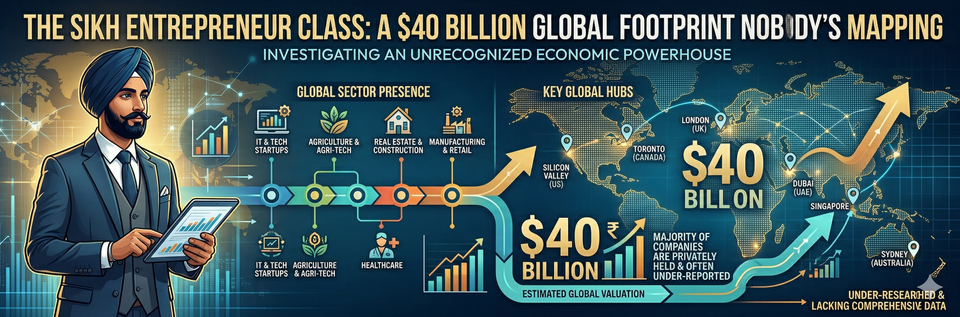
They run some of the world's largest companies. They dominate entire industries. They're the second wealthiest faith group in Britain and among the highest-earning ethnic communities in North America. And yet, as an economic force, the Sikh entrepreneurial class remains one of the most systematically undercounted stories in global business.
This is not a feel-good community profile. This is a forensic look at a $40 billion+ economic network built on a 500-year-old operating system one that business schools haven't studied, venture capital hasn't targeted, and journalists haven't mapped.
It's time someone did.
The Scale Most People Don't See
Start with the numbers. There are between 25 and 30 million Sikhs worldwide, making Sikhi the fifth-largest religion on earth. The overwhelming majority live in India, but significant communities exist on every inhabited continent, with the largest diaspora concentrations in Canada (approximately 771,800), the United Kingdom (around 524,000), the United States, and Australia (over 210,000).
Those population numbers look modest. The economic numbers do not.
The British Sikh Report found that two-thirds of British Sikh households have pre-tax incomes above £40,000, and over a third have household income exceeding £80,000. Taking into account the average size of the British Sikh household, the Sikh contribution to the British economy was valued at £7.63 billion. That figure is from 2014. With Sikh population growth, wage growth, and asset appreciation, a conservative 2026 estimate places the British Sikh economic contribution well above £12 billion.
Approximately one in three British Sikh families owns a business in the UK. Home ownership among British Sikhs stands at 87%, with 30% owning their homes outright. Only 1% claim Housing Benefit. For a community that is less than 1% of the UK population, these figures are extraordinary.
A UK government report ranked the wealthiest faith groups in Great Britain as follows: first, Jews. second, Sikhs. third, Christians. fourth, Hindus. That ranking Sikhs as the second-wealthiest faith group in one of the world's largest economies barely registered in mainstream media. A comparable finding about any other group would have been front-page business news.
Now extrapolate that across the global diaspora. Canada. Australia. Singapore. East Africa. The Gulf. Italy. The United States. And then layer in Punjab itself one of India's wealthiest and most agriculturally productive states, which generates substantial industrial and business wealth entirely off the global radar.
The $40 billion figure in this article's title is not hyperbole. It is arguably conservative.
The Operating System: Built Over 500 Years
To understand Sikh entrepreneurial success, you have to start at the source. This is not a community that stumbled into commercial success. It was designed for it philosophically and structurally from the very beginning.
Sikh Gurus established new towns like Amritsar, Tarantaran, and Kartarpur specifically as trade hubs, inviting traders, artisans, craftsmen, and shopkeepers to settle there. They wanted people to build wealth. The rise of ambitious Sikh millionaires can be attributed to adherence to the ethical principles of kirat karo (honest labour), naam jappo(remembrance of the divine), and wand chhako (sharing with others).
Three commands. Work honestly. Stay connected to something greater than profit. Share what you earn. This is not a theology of poverty or withdrawal. It is a theology of purposeful commercial engagement.
Academic research on religion and economic growth identifies that Sikh doctrine places strong emphasis on education, rational thinking, long-term planning, modest consumption, high investment, self-employment, and employment generation. Centuries before management schools codified these as virtues of successful enterprise, the Gurus had embedded them into the daily practice of the faith.
The concept of daswandh tithing one-tenth of earnings to the community created something modern economists would recognise as a redistributive capital pool. Daswandh has become an integral part of Sikh tradition. In Britain alone, it has driven the establishment of more than 200 gurdwaras through voluntary contributions. Those gurdwaras function not just as places of worship but as community infrastructure: free food, networking hubs, informal employment exchanges, and trust networks for business.
This is patient capital at a civilisational scale.
Geography of Dominance: Sector by Sector
The Sikh entrepreneur class doesn't scatter randomly across sectors. It clusters, dominates, and in some cases virtually isthe industry in certain geographies.
Transport and Logistics, North America
In Canada and the United States, Sikh entrepreneurs control a disproportionate share of the trucking and logistics industry. This is not well-documented in mainstream business press, but anyone in Canadian freight knows it. In British Columbia where Sikhs make up nearly 6% of the provincial population the community's grip on commercial transport logistics is foundational. Entire freight corridors operate through Sikh-owned fleets and distribution networks that connect the Pacific coast to the interior. This represents billions in annual revenue that appears nowhere in any analysis of "Sikh business."
Agriculture, Italy and the Punjab Diaspora
Italian Sikhs are heavily involved in agriculture, agro-processing, machine tools, and horticulture. Italy, particularly Reggio Emilia and the province of Vicenza, has become a fast-growing area for Sikh migration. Many Sikhs migrated to Italy after serving in the British Army during WWI and are now heavily represented in the country's dairy industry. A significant share of Italian Parmesan and mozzarella production passes through hands that once tilled the fields of Punjab. This is a story that has never been told in any mainstream food or agricultural publication.
Real Estate, Canada and the UK
Bob Singh Dhillon, CEO of Mainstreet Equity Corp, is the first Sikh billionaire in Canada, having built a massive real estate empire from the ground up. He is the public face of a much larger, quieter reality. Across the UK and Canada, Sikh families have deployed the proceeds of first-generation labour into property a classic wealth-compounding strategy across generations. With British Sikh home ownership at 87% in a country where average ownership rates hover around 65%, the community's real estate balance sheet is substantial.
Technology and Innovation
Narinder Singh Kapany is celebrated globally as the "Father of Fiber Optics," whose innovations revolutionised telecommunication and internet technology. He founded companies including Optics Technology Inc. and Kaptron. Without Kapany's breakthroughs, the internet as we experience it would not exist. He is a Sikh. This is rarely mentioned.
In Singapore, Kartar Singh Thakral expanded his family's trading business, Thakral Holdings, into assets totalling almost US$1.4 billion, making him Singapore's 25th-richest person.
In retail, the UK-based clothing retailer New Look was founded by Sikhs, as was the Thai-based JASPAL group. India's largest pharmaceutical company, Ranbaxy Laboratories, was headed by Sikhs. Apollo Tyres is headed by Onkar Singh Kanwar.
Global Finance and International Institutions
The most visible single data point in recent years is Ajaypal Singh Banga. Born into a Punjabi Sikh family, Banga served as the president and CEO of Mastercard from July 2010 until 2020, and has been the president of the World Bank Group since 2023. During his decade leading Mastercard, he tripled the company's revenue and Mastercard stock soared by more than 1,000 percent, outperforming competitors Visa and American Express.
A practising Sikh who wears his turban to every boardroom, every G20 summit, every state dinner Banga, conspicuous by his beard and turban, has often spoken about the importance of diversity. He runs the institution that holds $400 billion in assets and shapes the economic architecture of 189 countries. And he does it as an openly, visibly Sikh man.
The Structural Advantages No One Is Talking About
What gives the Sikh entrepreneurial class its edge? Four structural factors converge in a way that is genuinely rare in the global business landscape.
1. Trust Networks at Scale
The gurdwara system present in virtually every major city on earth functions as a global B2B and B2C network that no consultancy has ever attempted to value. When a Sikh entrepreneur lands in a new city, they have instant access to community, accommodation, introductions, and potential business relationships. This informal infrastructure reduces friction and transaction costs in ways that formal institutions cannot replicate.
2. Intergenerational Capital Formation
The pattern across the UK, Canada, and Australia is consistent: first generation works in labour-intensive industries; second generation moves into self-employment; third generation into professional services and larger enterprise. In the 1960s and 1970s, many Sikhs arrived in the UK to work in foundries, car manufacturing, and textiles. When these industries declined in the 1970s and 1980s, many turned to self-employment, using redundancy money and family capital to establish businesses. That pivot from employee to employer within one generation is a defining feature of Sikh economic history in Britain, and it has compounded into something formidable.
3. The Daswandh Multiplier
The practice of tithing is not merely charitable it is economically generative. Capital pooled through gurdwaras has funded schools, hospitals, community centres, and commercial infrastructure. It has created anchor institutions in communities that then attract further economic activity. No private equity firm has a model that captures this. It doesn't appear in any ESG framework. It operates in plain sight, completely invisible to mainstream economic analysis.
4. The Resilience Doctrine
Sikh ideology places special emphasis on entrepreneurial qualities, advocating that everyone should cultivate ethical diligence in their work. This is not a theological abstraction. It is a lived practice, embedded in identity. The Sikh entrepreneur is not merely pursuing profit they are performing a religious and cultural obligation. That intrinsic motivation produces a different quality of persistence, particularly under adversity.
Sikh entrepreneurs have had to fight against discrimination and prejudice in the business world, often facing setbacks due to their appearance or religious dress. Yet they have drawn on the strength of their community and the richness of their culture to build resilient and successful businesses that stand the test of time. Resilience under discrimination is not just a character trait. It is a competitive advantage.
The Political Class: Power Without Profile
Business success has translated into political influence, though again largely unmapped.
In Canada, Brampton, Ontario, home to 163,260 Sikhs, has the world's largest Sikh municipal population outside India. The political consequence is significant: Sikh Canadians hold federal cabinet positions, provincial legislative seats, and mayoralties across British Columbia and Ontario. At the peak of recent Canadian politics, there were more Sikhs in Canada's federal cabinet than in India's.
In Britain, Sikh MPs have been elected from constituencies across the Midlands, London, and the South. Sikhs have an 84% employment rate in the UK, with top sectors including public service, healthcare, accountancy, finance, and IT. This is a community that has moved remarkably quickly from factory floor to the floors of Parliament and boardrooms.
In the United States, Ravinder Singh Bhalla became the first Sikh mayor of Hoboken, New Jersey. More broadly, Sikh-Americans are increasingly present in technology leadership, venture capital, medicine, and law.
The Visibility Gap: Why This Story Isn't Being Told
Here is the uncomfortable question: if the Sikh entrepreneurial class is this significant, why does nobody map it?
Several reasons compound.
Data fragmentation. In most countries, Sikh identity is captured under "Asian," "Indian," or "South Asian" in business surveys. The specific Sikh economic contribution disappears into the broader South Asian category. UK Sikh experience is that most population figures understate Sikh communities by hundreds of thousands due to the unreliability of statistical classification systems under categories like ethnicity, ancestry, and religion. If the population is undercounted, the economic contribution is undercounted by a larger multiple.
The humility culture. Sikh philosophy is not given to self-promotion. Kirat karo honest labour does not come with a press release. The community builds, often quietly, without the narrative infrastructure that other groups have invested in. There is no equivalent of the Forbes Midas List that specifically tracks Sikh venture performance, no equivalent of the annual Jewish philanthropy reports that make that community's economic activity legible to the outside world.
Conflation with "South Asian." Much of the analysis of diaspora economic power groups Sikhs with Indians, with Punjabis, with South Asians at large. This obscures the specific cultural, religious, and organisational factors that make the Sikh entrepreneurial profile distinct. A Gujarati Hindu trader and a Sikh farmer-turned-entrepreneur have different histories, different networks, and different operating philosophies. Lumping them together produces analysis that explains nothing.
The absence of a convening institution. The Jewish community has the Anti-Defamation League, AIPAC, and numerous economic advocacy organisations that amplify its business achievements. The Sikh community, for historical and political reasons, has not built an equivalent global economic advocacy infrastructure. Individual success stories circulate within the community; they rarely break through to mainstream business media.
The Next Wave: Where the Capital Is Moving
The Sikh entrepreneur class is not static. It is evolving, and the direction of travel is significant.
The third-generation diaspora British Sikhs, Canadian Sikhs, American Sikhs who grew up not in factories or corner shops but in universities and professional firms is now entering its prime wealth-building years. They bring professional credentials, global networks, access to institutional capital, and the same deep-seated drive that characterised their grandparents. The difference is that they are operating in sectors technology, financial services, venture capital, media where scale compounds faster and more visibly than it does in trucking or dairy farming.
Simran Kaur, founder of Girls That Invest, has demystified investing for thousands globally through her podcast and educational tools, transforming lives particularly among women and minority communities. She is a single data point in a much larger trend: Sikh professionals building media, education, and financial platforms that serve both mainstream and community audiences.
The emergence of organisations like the Sikh Investors Club explicitly building wealth "as a Panth, for the Panth" signals a growing consciousness within the community about collective capital formation. The next decade will likely see Sikh-specific investment vehicles, business networks, and mentorship infrastructure that begin to formalise what has until now been largely informal.
This is the moment, in other words, when the unmapped starts to get mapped.
What the World Is Missing by Not Paying Attention
There are practical stakes to this invisibility.
For investors and capital allocators: The Sikh community represents an underserved and high-trust customer base, a disproportionately entrepreneurial supplier base, and a network of HNW individuals who have historically deployed capital through community channels rather than formal investment structures. That capital is increasingly seeking professional management and alternative asset exposure. The fund managers, fintechs, and wealth platforms that build genuine relationships with this community first will capture a significant and loyal segment.
For policymakers: A community that contributes £7.63 billion+ to the British economy while claiming almost zero in state support should not be an afterthought in industrial strategy. The same applies in Canada, Australia, and across the EU. The policy conversation about minority entrepreneurship consistently misses the Sikh community because the data isn't there. Building that data should be a priority.
For the community itself: The invisibility is self-limiting. Capital flows to where it is seen. Talent follows role models. The Sikh entrepreneurial class needs not just to build, but to narrate — to make its achievements legible to the next generation and to the outside world in a way that attracts further investment, partnership, and opportunity.
The Mapping Imperative
At 25-30 million people, Sikhs are 0.3% of the global population. Their economic footprint in terms of business ownership rates, household income, home ownership, professional attainment, and commercial leadership is many multiples of that demographic weight.
The man who ran the world's largest payment network and now leads the institution that finances global development is a Sikh. The father of fibre optics the technology that carries the modern internet was a Sikh. The first Indo-Canadian billionaire is a Sikh. The community that owns one-third of the UK's Punjabi businesses, runs dairy farms in the Italian Po Valley, operates freight networks across North America, and sits as the second-wealthiest faith group in Britain is Sikh.
Nobody is mapping this. Nobody is writing the comprehensive economic history of this community's commercial achievement. Nobody is building the data infrastructure that would allow policymakers, investors, and the community itself to understand the full scale of what has been built.
That needs to change.
The Sikh entrepreneur class did not arrive at $40 billion by accident. It arrived by design a design 500 years in the making, grounded in scripture, forged in displacement and discrimination, and expressed in the relentless, purposeful, quietly extraordinary act of building.
The least the world can do is start paying attention.
The $40 billion figure represents a conservative aggregate estimate of Sikh-owned business turnover, household wealth, and institutional economic contribution across the primary diaspora markets (UK, Canada, USA, Australia) and Punjab-based industry, drawing on available data from the British Sikh Report, Hansard parliamentary records, and regional economic surveys. Comprehensive global data does not currently exist which is precisely the point of this article.
Member discussion