
The Punjab 95 Affair: How a Democracy Censors Its Own History
I. The Film They Don't Want You to See
For more than two years, a finished film has been sitting in a vault, waiting. Punjab 95, starring Diljit Dosanjh as the human rights activist Jaswant Singh Khalra, is a film about court-documented atrocities, convicted killers, and a man who was murdered for telling the truth. The Central Board of Film Certification (CBFC) has demanded over 127 cuts. The film has no release date. Its own director has now walked away.
This is not a story about a film.
It is a story about the architecture of forgetting how a democracy, the world's largest, manages the past when the past is too damning to survive contact with the present. The Punjab 95 affair is not an anomaly. It is a case study. And the case it makes is worth reading with full attention.
II. The History the Film Depicts
To understand what India's censorship apparatus is trying to suppress, you have to understand what happened in Punjab between 1984 and 1995.
The decade began with catastrophe. Operation Blue Star in June 1984 the Indian Army's assault on the Golden Temple complex in Amritsar to flush out Sikh leaders was a traumatic rupture. The assassination of Prime Minister Indira Gandhi by her Sikh bodyguards that October unleashed organised anti-Sikh pogroms across India in which thousands were killed, many of them in Delhi, with documented complicity from Congress & BJP (Ruling) party politicians. The state of Punjab then descended into a decade of insurgency, counter-insurgency, and industrialised state violence.
Following Operation Blue Star, the assassination of Indira Gandhi, and the 1984 anti-Sikh pogroms, the police were empowered to detain suspects for any reason, ostensibly as suspected terrorists. The police were accused of killing unarmed suspects in staged shootouts and burning thousands of dead bodies to cover up the murders.
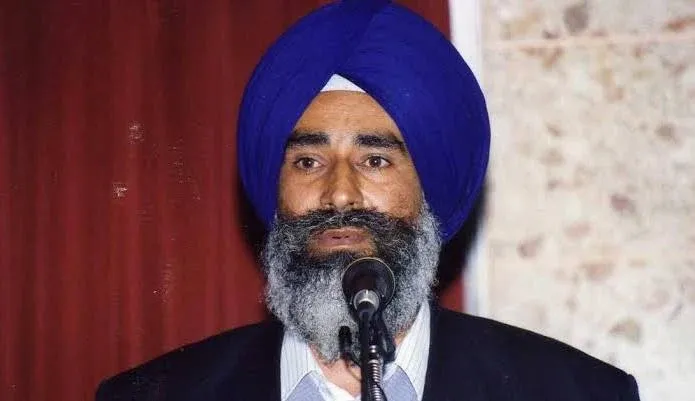
Into this climate stepped Jaswant Singh Khalra a bank director from Amritsar, not a politician, not a professional activist. Through painstaking research, Khalra uncovered that from 1987 to 1993, over 25,000 Sikh men and women were secretly abducted, tortured, killed, and illegally cremated by the Punjab Police. Families were left without answers, and countless lives disappeared into silence. What was most shocking was the methodical nature of these crimes police and state officials were complicit in conducting cremations without notifying families, effectively erasing evidence of extrajudicial executions.
Khalra's method was forensic and methodical. He focused his investigations on three cremation grounds Patti, Tarn Taran and Durgiana Mandir all in the Amritsar district. His investigative work led him to examining receipts for firewood used in cremations, showing the quantity bought by the police. Three hundred kilograms of wood was required for each body. In this way, he was able to deduce that there had been a series of inexplicable spikes in the number of cremations of 'unidentified and unclaimed' corpses at certain times. He matched dates and numbers with records kept by the Municipal Committee of Amritsar.
In January 1995, he went public. He filed petitions in court. He travelled to Canada and addressed the Canadian Parliament directly.
"Thousands of mothers await their sons," Khalra told a Canadian audience in June 1995. "Even though some may know that the oppressor has not spared their sons' lives on this earth. But a mother's heart is such that even if she sees her son's dead body, she does not accept that her son has left her. So the mothers who have not even seen their children's dead bodies they were asking us, at least find out: is our son alive or not?"
Three months after that speech, on the morning of 6 September 1995, Khalra was last seen washing his car outside his home in Amritsar. He was taken that day by Punjab Police officers. He would not return alive.
From his abduction on September 6, 1995 until his eventual murder on October 27, 1995, Khalra endured unspeakable torture and abuse. A witness later testified that he was shot twice in the chest, his body thrown into the Harike canal. The officers who disposed of the body were reportedly rewarded with two bottles of liquor.
The Indian government, when pressed by Canadian officials, denied that police had abducted him at all. In a letter clarifying the government position, the former Governor of Punjab, S.S. Ray, said that the kidnappers were merely "masquerading as policemen".
This was a lie that courts would eventually dismantle. It took ten years to bring Khalra's murder to trial. In 2005, six police officials were convicted. In 2007, the Punjab and Haryana High Court upheld five convictions, enhancing all sentences to life imprisonment. In November 2011, the Supreme Court of India upheld the convictions and sentences.
The Supreme Court of India not a Sikh separatist pamphlet, not a foreign NGO confirmed what Khalra had died trying to prove. The state had murdered him. The state had murdered thousands of others. This is established, adjudicated, legally certified fact.
And this is precisely what Punjab 95 depicts.
III. The Censorship Machine
Directed by Honey Trehan and produced by Ronnie Screwvala's RSVP Movies, the film was initially slated to premiere at the Toronto International Film Festival (TIFF) in 2023. But Indian authorities intervened, prompting the filmmakers to withdraw. Since then, Punjab 95 has faced an uphill battle with the Central Board of Film Certification (CBFC), resulting in a staggering 127 demanded cuts.
The specific nature of those demands is instructive. This was not a dispute about cinematic taste or audience appropriateness. Trehan says some of the CBFC's demands have been "verbally non-negotiable," including removing the name "Khalra," deleting visuals of the Indian flag, muting Gurbani sounds, avoiding the term "Punjab police," changing names of locations, and renaming the film itself.
Read that again. The board demanded the removal of the name of the protagonist a real man, convicted murderers of whom are currently serving life sentences in Indian prisons. It demanded that the film not mention the Punjab Police the institution that Indian courts found guilty of those killings. It demanded the removal of Gurbani Sikh scripture from a film about a Sikh man. It wanted references to 25,000 extrajudicial killings erased from a film about the person who documented those killings.
"They wanted us to remove the name of the protagonist and to remove the Indian flag. They didn't want us to mention the 25,000 extrajudicial killings or portray the Punjab police in a negative light. They also asked us to make this a work of fiction. But all these things are a matter of public record, so it doesn't make any sense to remove them from the film," Trehan told Deadline.
Making it a "work of fiction" the most damning demand of all. The state is not asking for accuracy. It is asking for the deliberate manufacturing of unreality around events it cannot rewrite in the courts but desperately needs to obscure in the culture.
Trehan says the producers were told the film would receive a censor certificate if they agreed to the 21 cuts, removed the case from the High Court and also removed the film from TIFF. "I was heartbroken, but said let's do it, let's make those changes, because we really couldn't see any other way to get the film released."
Even capitulation did not work. After the agreed cuts were made, the CBFC simply escalated its demands. The film was renamed Sutlej. Further cuts were made. Now Trehan and Dosanjh are walking away. "This is not my film, and I'm withdrawing my name from it," Trehan declared.
IV. The Demolished Appeals Process
What makes this censorship particularly surgical is the deliberate removal of the mechanism through which filmmakers could fight back.
Between 1952 and 2021, India had a body that enabled filmmakers to appeal decisions of the CBFC the Film Certification Appellate Tribunal (FCAT) but it was abolished four years ago, which means that filmmakers now have no option but to engage a lawyer and petition the High Court.
The abolition of the FCAT in 2021 was framed at the time as bureaucratic rationalisation. In context, it reads differently. By removing the specialist appellate body, the government dramatically increased the cost and difficulty of challenging CBFC decisions. A filmmaker now has to fund full High Court litigation expensive, slow, and subject to the same political environment to contest demands to rename their own protagonist.
When the producers of Punjab 95 did exactly that, the response was revealing: Trehan says the producers were told the film would receive a censor certificate if they agreed to the cuts, removed the case from the High Court, and removed the film from TIFF. In other words: drop your legal challenge, remove yourselves from international scrutiny, and then perhaps we will let you exist. The condition was not just censorship of content. It was censorship of legal process.
"No reasons have been given formally. I am willing to cut anything if it's a court directive, but I am not being allowed to fight in court," Trehan has said.
This is the machinery made visible. Not a ban with a rationale that can be argued against. Instead, an informal, unaccountable process of verbal demands, unexplained escalations, and pressure to withdraw the very legal mechanisms that might expose the arbitrariness of the whole system.
V. The Double Standard
The censorship of Punjab 95 does not exist in isolation. It is made sharper by what the CBFC has not suppressed.
The Kashmir Files (2022) a film depicting the persecution of Kashmiri Pandits, produced with significant political visibility faced no such obstacles. It was cleared without difficulty, screened in Parliament, praised by senior government ministers, and offered tax exemptions across multiple BJP-governed states. The prime minister publicly endorsed it.
Sukhbir Singh Badal, the Shiromani Akali Dal chief, made this contradiction explicit: "The same Censor Board did not feel it fit to censor the Kashmir Files which speaks about the agony of Kashmiri Pandits. This gives the impression that the Board is biased in its outlook towards minority communities."
The principle being applied is not one of public order or artistic decency. It is political. Films that confirm the preferred historical narrative of the ruling establishment receive rapid clearance; films that document state violence against minority communities documented by Indian courts are buried under procedural obstruction.
The CBFC's concern about Punjab 95 allegedly centred on potential violence in Sikh communities and damage to India's international relations. But the events the film depicts were confirmed by India's own Supreme Court. The perpetrators were convicted by India's own courts. The logic that acknowledging this judicially-proven history would incite the Sikh community implies, perversely, that Sikhs cannot be trusted with knowledge of their own certified legal history.
VI. A Pattern, Not an Incident
Punjab 95 is the highest-profile case, but it is part of a documented acceleration.
Sandhya Suri's Santosh, a thriller focused on caste violence, police brutality, and Dalit injustice, despite being the United Kingdom's Oscar entry and earning a BAFTA nomination, reportedly faced a ban in India. The decision was reportedly based on concerns about negative portrayal of the police and caste issues. Internationally, the film received strong praise from critics and audiences.
In December 2024, two Bengaluru-based developers created CBFC Watch, the first public, searchable database of every modification demanded by the board from 2017 to 2025. They stacked up over 100,000 modifications from nearly 18,000 films. In a telling move, when the database went public, the CBFC quickly restricted public access to certification details on its portal.
The data itself tells part of the story. Political and religious edits, which sit at 2,621 and 2,589 changes respectively across the database, the developers note are "more concerning" than the surface-level statistics because muting politician names or removal of caste-related terms fundamentally rewrites meaning.
And then there is the phenomenon the database cannot capture at all. As one filmmaker put it: "The crippling anxiety of offending sentiments compels filmmakers to pre-emptively self-censor at the scripting stage itself, long before the CBFC wields its scissors." The most effective censorship never appears in any database. It never needs to. It operates in the mind of the writer before the first word is typed.
According to the World Press Freedom Index, India's press freedom ranking dropped from 140 out of 179 countries in 2019 to 161 out of 180 countries in 2023. Freedom House's 2024 Freedom in the World report gave India a score of 66 out of 100, corresponding to "partially free" a significant deterioration from 2017 when India scored 77 out of 100 and was classified as simply "free".
India recorded 14,875 documented free speech violations in 2025 alone, including nine killings, mass censorship targeting thousands of social media accounts, and the return of colonial-era sedition charges against journalists and satirists.
VII. Why This Matters Beyond India
The international dimensions of the Punjab 95 affair are not peripheral. They are structural.
Jaswant Singh Khalra delivered his most significant public statement in the Canadian Parliament. His research was supported by international human rights organisations. His murder prompted interventions from Canadian politicians, Amnesty International, and Human Rights Watch. Relations between India and Canada have been at an all-time low since 2023 when former Canadian Prime Minister Justin Trudeau alleged that Indian agents were involved in the killing of Canadian citizen Hardeep Singh Nijjar, leader of a Sikh separatist movement.
In that geopolitical context, a film with scenes set in the Canadian Parliament, depicting Indian state violence against Sikhs, carrying a TIFF selection the pressure to kill it internationally becomes fully legible. This is not simply domestic censorship. It is image management for an increasingly contested global reputation.
The CBFC's alleged concern that Punjab 95 could "have a negative impact on India's relations with other countries" is, in this light, an admission. The problem is not that the film is inaccurate. The problem is that it is accurate, and that accuracy, in the current diplomatic environment, is inconvenient.
This is what makes the affair philosophically significant as well as politically important. The censorship is not premised on falsehood the board is not claiming the events depicted did not occur. It is premised on the management of what facts are permitted to circulate as cultural memory. History that has been settled in a court of law is still being treated as too dangerous for a cinema screen.
VIII. The Khalra Legacy in the Present Tense
The Sikh Coalition describes Jaswant Singh Khalra as a dedicated human rights activist who courageously exposed widespread human rights violations and atrocities during the "decade of disappearances" that followed the Sikh Genocide in 1984. His tireless efforts to uncover the truth about enforced disappearances, extrajudicial killings, and secret cremations brought international attention to the plight of Punjab's disappeared and their families. As a result of his work, he was abducted, tortured, and murdered.
In Fresno, California, a public elementary school now carries his name. In Canada, community organisations hold annual commemorations. KPS Gill, the head of the Punjab Police responsible of orchestrating the violence of that era and implicated in Khalra's murder, died in 2017 without ever facing trial for his role in Khalra's death, despite sustained campaigns by Human Rights Watch and Ensaaf.
The Punjab Documentation and Advocacy Project continues its work. A Public Interest Litigation concerning disappearances and fake encounters of over 8,257 Punjabis has been filed in the Supreme Court of India by the Punjab Documentation and Advocacy Project. The legal reckoning is still incomplete. The cultural reckoning is now being actively prevented.
IX. The Fundamental Question
There is an argument, made by those defending the CBFC's posture, that goes something like this: India is a diverse, fragile society; certain historical events are too inflammatory; films can be weaponised; public order is a legitimate state interest. Each of these points has some abstract validity.
But none of them survive contact with the specific facts of this case.
The events depicted in Punjab 95 are not contested. They have been adjudicated by India's own highest court. The perpetrators are serving life sentences handed down by Indian judges. The number of victims was confirmed by India's National Human Rights Commission. The protagonist is a man who has a school named after him in California and whose killer was convicted by an Indian court. This is not a volatile, disputed history. It is settled law presented as cinema.
What the CBFC is doing and what the abolition of the FCAT was designed to enable is preventing the democratic public of India from encountering their own country's certified legal history in an emotionally accessible form. The argument is not that the facts are wrong. It is that the facts, rendered as a Diljit Dosanjh film that twenty million people might watch, are too powerful to allow.
That is not censorship as public order management. That is censorship as historical engineering. And it is being conducted, with considerable sophistication, by a democracy that holds elections, has an independent judiciary, and describes itself as the world's largest practitioner of the form.
X. The Silence That Remains
The police had received threats for Khalra while he was still alive: "We have disappeared 25,000 people. We have no problem if that's 25,001," his wife Paramjit recalled being told.
They were right that making him the 25,001st would not be a problem at least not for a generation. He was murdered. His work was buried. The records he had not yet reached were sealed. The state continued.
What Paramjit Kaur Khalra, who has fought for justice for thirty years, and what Honey Trehan, who has spent two years watching his film dismantled demand by demand, and what every filmmaker now sitting at a keyboard deciding what is safe to write what all of them understand is this: the murder of Jaswant Singh Khalra was the first act of suppression. The CBFC's treatment of Punjab 95 is simply a more institutional version of the same impulse.
Khalra was killed because he found the firewood receipts. Punjab 95 is being killed because it would tell twenty million people what those receipts meant.
The method has changed. The objective has not.
The film Punjab 95 remains unreleased in India. Director Honey Trehan has withdrawn his name from the version that complied with censorship demands. Diljit Dosanjh has also withdrawn his endorsement of the cut version. Jaswant Singh Khalra's murder is confirmed by the Supreme Court of India. Six Punjab Police officers are serving life sentences for that murder. The 25,000 families whose loved ones were cremated in secret are still waiting for full accounting.
Member discussion