
The Made to Order Sikh
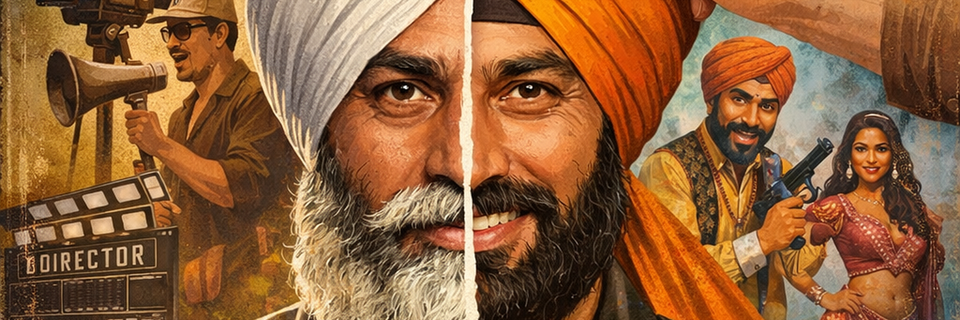
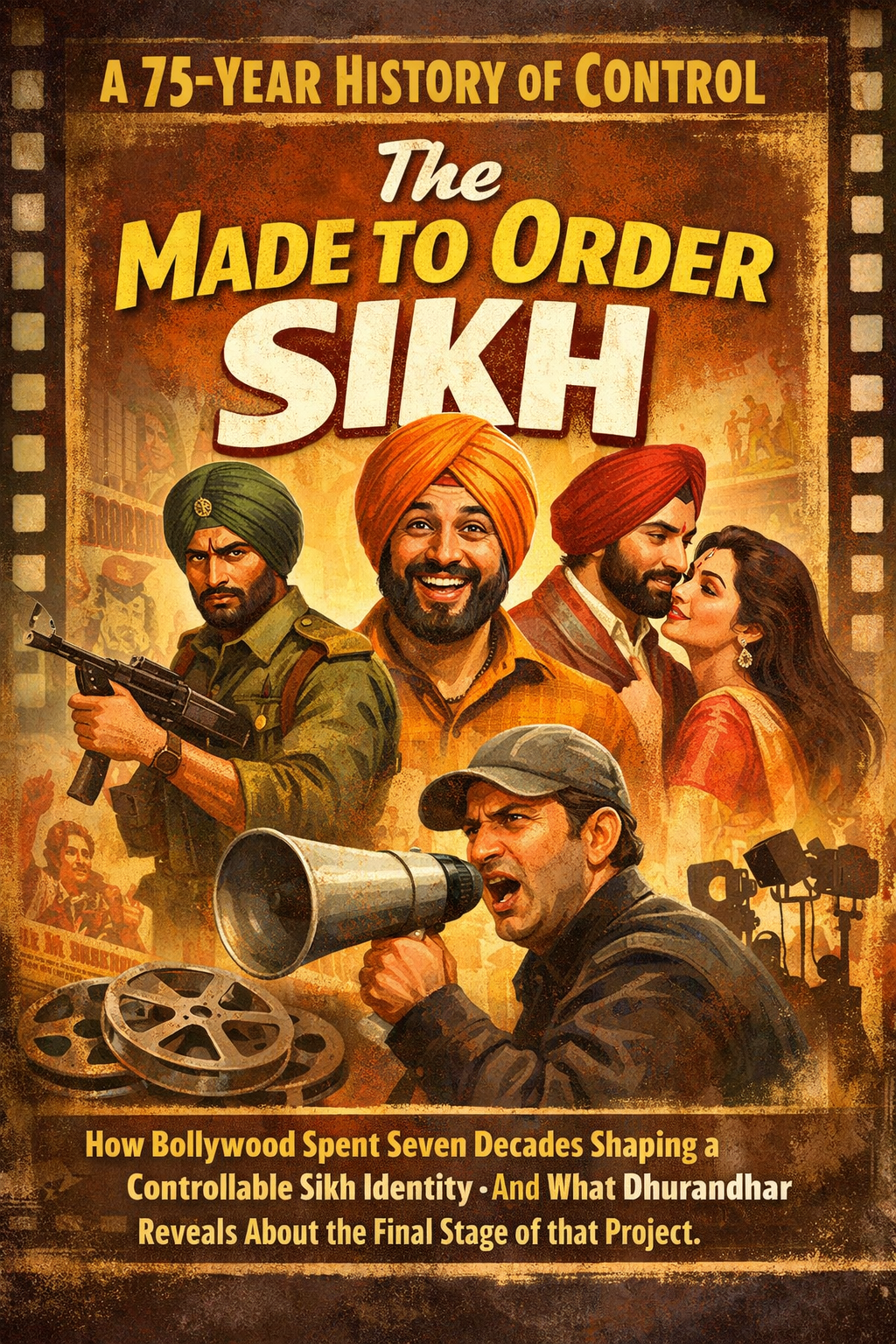
A 75-Year History of Control: How Bollywood spent seven decades building a version of Sikh identity that was easier to manage and what Dhurandhar reveals about the final stage of that project.
Here is something that should make you stop and think. In 2025, one of Bollywood's biggest blockbuster (Dhurandhar & Dhurandhar The Revenge) centres on a Sikh man. He is the hero. He carries the film on his shoulders for nearly seven and a half hours. In the final scenes his turban is immaculate. His resolve is iron. And yet by the time the credits roll something essential about what it actually means to be Sikh has been quietly, efficiently, almost surgically removed.
This is not an accident. It is the endpoint of a project that began the moment India became a nation in 1947. A project to make the Sikh identity usefu For who you may ask? useful to the state, useful to the box office, useful to everyone except the 25 million people it actually belongs to.
What follows is not a takedown of a single film. It is a map of a system. Five phases across eight decades. Each one building on the last. Each one a little harder to see from the inside.
CHAPTER 1 (Phase One · 1947–1984)
Making the Sikh Invisible
Independence to Operation Blue Star
When India gained independence in 1947, the project of building a unified national identity began almost immediately. And it had a problem. The Sikh community's entire foundational history is one of principled resistance to Mughal authority, to colonial power, to any demand for assimilation.
The Khalsa, the community of initiated Sikhs established by Guru Gobind Singh in 1699, was not designed to blend in. The five K's the unshorn hair, the steel bracelet, the ceremonial dagger are deliberate, visible declarations of a separate and sovereign selfhood.
That kind of identity does not sit comfortably within a nationalist project that requires a unified, legible, manageable "Indian."
The early Bollywood response was elegant in its simplicity: don't engage with it. Films like Naya Daur (1957) and Upkar (1967) featured Sikh characters as background texture, scenic, warm, physically impressive, and philosophically mute. You saw the turban. You saw the beard. The turbaned extra waved a flag, drove a tractor, smiled broadly. But the screen never asked what he believed, what his community had sacrificed, what his relationship to the state actually was.
Academic research published in the journal Sikh Formations confirms this pattern, in the nationalist cinematic framework of this era, in which the imagined Indian subject was understood to be an urban, North Indian, Hindu male, Sikh characters were systematically displaced from the centre of their own stories, included only to perform diversity while contributing nothing to the actual narrative of Indian identity.
"You saw the turban. You never heard the soul. That was precisely the point."
The Sikh community was, during this period, making enormous contributions to independent India. They dominated agriculture in Punjab, which became the engine of the Green Revolution that saved the country from famine. They were disproportionately represented in the armed forces. They were building cities, running businesses, feeding a nation. And on screen, they were waving in the background. The editing of the Sikh into a cheerful extra was not neutral. It was a political act dressed as a creative choice.
CHAPTER 2 (Phase Two · 1984–1992)
The Dangerous Label
After Operation Blue Star and the anti-Sikh pogroms
June 1984. The Indian Army storms the Golden Temple in Amritsar,the holiest site in Sikhs to remove who they described as a militant leader, one who was simply a man standing up for his own people. The operation kills hundreds of civilians sheltering in the complex, damages the sacred Akal Takht, and sends a message to the Sikh community about exactly where it stands in relation to the Indian state.
Five months later, Prime Minister Indira Gandhi is assassinated by her Sikh bodyguards. What follows is not a riot. It is a pogrom. Organised mobs, in many cases reportedly guided by electoral rolls and voter lists, kill an estimated 3,000 to 8,000 Sikhs across India (according to India's own numbers) the reality the numbers were in thousands, majority of them in Delhi, over four days. Decades later, survivors are still waiting for justice.
The cinematic response to this catastrophe was swift and instructive. The invisible Sikh of the previous era could no longer hold. The community was now front-page news, impossible to background. So the script changed. The pleasant, turbaned extra became a threat. Films and television of the period began associating the Sikh male body with militancy, instability, and violence. The word "Khalistan" the name given to a proposed separate Sikh homeland became a cinematic shorthand for extremism. The man in the turban was no longer waving a flag. He was planting a bomb.
"The man in the turban was no longer waving a flag. He was planting a bomb. The shift happened almost overnight not because the community had changed, but because the state's needs had."
What is important to understand is the function this served. The 1984 pogrom was a state-adjacent atrocity. Implicating Sikh men as inherently dangerous as the natural instigators of their own destruction, deflected from the question of accountability. It inverted the victim and the perpetrator. It is the oldest propaganda technique in the world, and it worked. An entire generation of Indian cinema audiences absorbed a version of events in which the turbaned man was the problem, not the subject of grievous injustice.
This phase is also significant for what it reveals about how media operates during periods of state violence. When governments commit or permit atrocities against minority communities, the cultural apparatus almost always follows with a narrative that naturalises the violence. The Sikh experience in 1984 is a case study in how that mechanism works in a democracy.
CHAPTER 3 (Phase Three · 1990s–2010s)
From Threat to Punchline
The great sardar joke cycle
Once the political urgency of the militancy era faded, Bollywood found a third, subtler, more durable instrument of control, COMEDY. If you cannot make people fear a community, make them laugh at it. A community that is a punchline is a community that has been stripped of gravitas without a single shot being fired.
The sardar joke has deep and contested roots in Indian popular culture. Research into the cycle suggests its origins may lie in competitive resentment scholars have noted that the jokes may reflect anxieties within non-Sikh communities about the success, prosperity, and self-sufficiency of Sikhs, particularly in Panjab & Delhi and within the diaspora. The stereotypes themselves the loud, the clumsy, the physically powerful but intellectually dim Sardarji are inversions of actual Sikh achievement and values.
Consider what the jokes actually mock. The "12 o'clock" joke, which implies Sikhs lose their senses at noon, directly inverts a celebrated moment of Sikh military heroism the midnight guerrilla raids by Sikh forces to free abducted women from Nadir Shah's army in the 18th century. The Santa-Banta joke names trace back, in popular memory, to the names of Indira Gandhi's assassins. In other words, the most common Sikh jokes in India are built on corrupted memories of either Sikh courage or Sikh victimhood. The joke is always the wrong way around.
"The jokes mock what they should celebrate. The '12 o'clock' jibe inverts a moment of documented Sikh military heroism. Even the laughter was stolen from them."
Bollywood industrialised this. Films like Son of Sardaar (2012), Singh Is Kinng (2008), Namaste London (2007) and Humpty Sharma Ki Dulhania (2014) gave the world a standardised sardar: loud, lovable, physically enormous, emotionally simple. A character always available for comic relief. Academic analysis published in Sikh Formations describes how Bollywood, rather than engaging authentically with the community, instead "genuflected to the rising economic and political power of the Sikh diaspora through token inclusions" deploying the turban as a cultural accessory rather than a signifier of a living philosophy.
The effect on the community was real. Stand-up comedian Jaspreet Singh, who called out Bollywood's Sikh stereotyping to mass response online, noted that these portrayals accumulate. "It feels weird when you see a relatable character in a stereotypical portrayal," he said. When you are laughed at, daily, from childhood, from every screen, in every context it reshapes how you see yourself. That is not a small thing. That is the slow demolition of a self-image.
Real Sikh History
Guru Gobind Singh created the Khalsa as sovereign, warrior-scholars bound to defend the powerless.
Sikh guerrilla forces rescued thousands of abducted women via midnight raids on invading armies.
Thousands of Sikhs were killed in the 1984 pogroms, Woman Raped, Families destroyed. Six police officers were later convicted for the murder of activist Jaswant Singh Khalra alone.
The five K's are articles of faith representing sovereignty, discipline, and community.
Bollywood Version
The Bollywood Version: The turbaned Sikh, big body, small brain, used for action scenes and comic relief.
The "12 o'clock" joke: Sikhs go crazy at noon. The heroism becomes the punchline. Growing up in Delhi I had that thrown at me at least once a day, and there is a point where you just start ignoring.
The militant Sikh of 1980s cinema: the turban equals the threat. The victim is recast as the aggressor.
Dhurandhar: the character smokes while he is reciting gurbani to a sikh character to evoke nationalism. . Punjab 95: the CBFC demands even the sound of Gurbani be cut.
CHAPTER 4 (Phase Four · 2010s–Present)
The Modernity Erasure
When breaking the faith becomes relatable
The fourth phase is more sophisticated and therefore more insidious than anything that came before. It does not fear the Sikh or mock the Sikh. It embraces the Sikh while systematically detaching the character from everything that makes a Sikh a Sikh. Running fake narratives like Sikhs are Hindus.
Films like Manmarziyaan (2018) and elements of Dil Dhadakne Do (2015) introduced Sikh characters who smoke, who remove their turbans casually, who exist in breezy indifference to their own faith's disciplines. This is sold under the banner of modernity, of relatability, of complexity. But what it actually performs is severance. The character keeps the surface aesthetics the name, the beard, occasionally the turban while the philosophy, history, and discipline of Sikhi is treated as irrelevant background noise.
This matters because the discipline of Sikhi the Rehit Maryada, the code of conduct established for initiated Khalsa Sikhs is not incidental to the identity. The five K's are not costume. Smoking, for a Sehdhari, Keshdhari or Amritdhari Sikh, is not simply a personal choice, it is incompatible with their initiated faith. Treating these elements as interchangeable props for whichever story a filmmaker wants to tell is not nuance. It is the same move the first phase made treating the visible markers of Sikh identity as decoration but now the decorator calls it progressive.
"Modernity became the excuse. But stripping a community's faith of its meaning and calling it complexity is not sophistication. It's a cleaner form of the same old erasure."
The parallel shift in the wider Panjabi cultural representation is also worth noting. Films and series increasingly present Panjabi identity as synonymous with wealth, parties, and agricultural prosperity a kind of aspirational rural opulence while the philosophical and spiritual dimensions of Sikhi quietly disappear. Sikh prayer, Gurbani, the Ardas these appear rarely, and when they do, they function as set dressing. The spiritual core of the community has been aestheticised into background music.
CHAPTER 5 (Phase Five · 2025 - Ongoing)
The Dhurandhar Trap
Assimilation as the final form
And so we arrive here. Dhurandhar, released in December 2025, is a genuine phenomenon. It has grossed over ₹1,350 crore worldwide, making it the highest-grossing Indian film of 2025 and the second-highest-grossing Hindi film ever made. Ranveer Singh's performance as the covert operative Jaskirat Singh Rangi who adopts the identity of Hamza Ali Mazari to infiltrate Pakistan's criminal and intelligence networks received widespread praise for its restraint and intensity. The film is, by the measures of the industry, an unqualified triumph.
It is also, by the measures of this argument, the final form of everything described above.
The hero is Sikh in name and origin. His backstory, in the sequel Dhurandhar: The Revenge (released March 2026), traces his roots as Jaskirat Singh Rangi. But the Sikh identity is a launch pad, not a destination. It is the raw material from which a loyal state operative is manufactured. The character has no independent political voice, no relationship to Sikh community or history that exists outside of his utility to the Indian intelligence apparatus. The turban, when he wears it, is a weapon of disguise. The faith, when referenced, is backdrop.
"The hero looks like a State image of a Sikh. He thinks exactly like the state wants him to. In ₹1,350 crore of box office, nobody noticed the trade."
The controversy around the sequel reinforces the critique. A Sikh organisation in Mumbai, Sikhs in Maharashtra filed a police complaint against the filmmakers and Ranveer Singh over promotional material showing the character in sacred Sikh symbols while holding a cigarette. The organisation's complaint was ultimately complicated by the revelation that the offending poster was fan-made using AI, and not official. But the broader objection that the franchise deploys Sikh iconography while showing contempt for Sikh values had not been resolved by the clarification. It had merely been muddied.
The franchise exists within a wider political economy that should be named. Films with narratives aligned to the state's preferred version of recent history The Kashmir Files, The Kerala Story, The Sabarmati Report, Article 370 receive release certificates, promotional infrastructure, and massive box-office backing.
Films that challenge that version of history face a different fate entirely.
CHAPTER 6 The Counter-Evidence
What Happens When the Real Story Tries to Get Made
The Punjab 95 case
The most powerful evidence for the argument being made here is not a film that was released. It is a film that wasn't.
Punjab 95, directed by Honey Trehan and starring Diljit Dosanjh, tells the true story of Jaswant Singh Khalra, a Sikh human rights activist who discovered that Punjab Police had secretly cremated more than 25,000 unidentified bodies during the militancy era of the 1980s and 1990s. Many of these were extrajudicial killings. Khalra documented the evidence, took it to the Canadian parliament, refused political asylum and chose to return to India, where he was abducted from his home by Punjab Police in September 1995. His body was never recovered. Six police officers were later convicted of his murder by the Supreme Court.
This is not a disputed or contested story. It is confirmed by Indian courts. The convictions are on record.
In December 2022, Trehan submitted the completed film to the Central Board of Film Certification. What followed was a years-long nightmare. The CBFC demanded over 127 cuts not minor adjustments, but systematic excisions. The board asked for the removal of Khalra's name. The word "Panjab" from "Punjab Police." The "based on true events" tag. The opening sequence depicting police killing civilians. The figure of 25,000 deaths a number verified by courts the board reportedly wanted reduced. Even sounds of Gurbani, sacred Sikh scripture, were flagged for removal.
"The CBFC wanted to reduce the body count. Trehan asked them: would 5,000 be more acceptable? That is the level of absurdity we are talking about."
Director Trehan eventually went public, most notably in a searing conversation with comedian Kunal Kamra. His account is precise: "They told us to remove the reference to Jaswant Singh Khalra. But my film is about Jaswant Singh Khalra."
He noted the obvious asymmetry: The Kashmir Files, The Kerala Story, The Bengal Files all films with far more contested factual claims received their certificates and their audiences without obstruction. "How come there was no law and order during the release of these films?" he asked. "Sirf iss film mein kaise ho jaayegi?" (How can it only happen with this film?)
The Akal Takht and the Shiromani Gurdwara Parbandhak Committee, the supreme Sikh religious authorities, screened the film and expressed no objection. Panjab's media raised no alarm. The state's concern, apparently, was not Sikh sentiment. It was Sikh history.
The film that tells the truth about what happened in Panjab continues to be suppressed, while the film that offers a Sikh hero scrubbed of any independent political consciousness earns ₹1,350 crore.
That is not irony. That is the system working exactly as designed.
Note: The Film Certification Appellate Tribunal, the body that allowed filmmakers to appeal CBFC decisions was abolished in 2021. Filmmakers now have no option but expensive High Court litigation. As Trehan has stated, even that route was compromised when producers were reportedly pressured to withdraw their court case as a condition of receiving a certificate.
CHAPTER 6 The Final
When the Song Became the Cage
How Panjabi music and cinema quietly replaced a complex Sikh identity with something far easier to sell and far easier to control following the Indian state narrative.
If Bollywood built the broad architecture of a "manageable Sikh identity," Panjabi cinema and music didn't stand outside that system. They became its amplifier but in a more intimate, more seductive language.
Because Panjabi media operates from inside the community rather than portraying it from the outside, its influence is subtler, more emotional, and arguably far more powerful. What Bollywood framed, Panjabi media normalized, the sikh image, the comedy, casteism.
The Internalization Phase
After the trauma of Operation Blue Star and the 1984 anti-Sikh riots, Punjabi cinema had a genuine opportunity to become a space of resistance, memory, and political truth. Instead, what emerged through the late 1990s and 2000s was a careful, deliberate pivot.
- Move away from political memory
- Avoid state violence narratives entirely
- Reframe Sikh identity into safe, celebratory tropes
- Anchor everything in romance, family, comedy
- Push Caste into Sikhi,
- Bring divide of Sikhs based on regions in parrallel with the policies
"This wasn't always explicit censorship. It was something more insidious, market conditioning. Nobody banned anything. The audience was simply never offered the alternative."
The Song as a Delivery System
Panjabi songs became the single most effective vehicle for embedding identity narratives more than films, more than literature, more than anything else.
What did decades of Panjabi music consistently reinforce? The Sikh male as, fun-loving, alcohol-consuming, romance-obsessed, materialistic. Artists like Daler Mehndi popularized the high-energy, celebratory image globally. Later, Yo Yo Honey Singh and Guru Randhawa shifted it further into hyper-consumerism, sexualized romance, and a Westernized aspiration completely detached from history.
The message became extraordinarily consistent. Be visible. Be loud. But do not under any circumstances be political.
The Erasure of the Saint-Soldier
Historically, Sikh identity is rooted in the sant-sipahi ethos spiritual depth fused with resistance. The warrior who also reads. The scholar who also fights.
In mainstream Punjabi songs, something different happened to these symbols:
- The "Singh" became aesthetic, not ideological
- The turban became style, not sovereignty
- The beard became branding, not identity
Even when "warrior" imagery appears, it's stripped of all context no Sikh struggles, no historical grounding, just stylized aggression. The Battle of Saragarhi goes unsung. Political resistance post-1947 goes unmentioned. The past isn't denied. It's simply never brought up.
The Quiet Substitution:- The Sikh is no longer a historical subject. They are a lifestyle aesthetic. And aesthetics, unlike history, don't demand anything from you.
The Diaspora Feedback Loop
The Panjabi diaspora particularly in the UK and Canada didn't escape this conditioning. They amplified it. Music produced for diaspora audiences avoided controversial politics to stay commercially viable, focused on party culture and identity-lite symbolism, and reinforced a "global Panjabi" identity, castism is now a proud estate, culturally visible, politically neutral.
Punjabi media simplifies identity removes historical depth, foregrounds lifestyle.
Diaspora consumes and amplifies it carries it into weddings, parties, daily life globally.
Industry doubles down what sells gets made again, the loop closes tighter.
What Was Actually Lost
The issue has never been that Panjabi songs are fun, commercial, or romantic. Joy has its own value. Celebration matters.
The issue is what was quietly displaced over decades to make room for all of it:
- Memory became optional
- Identity became aesthetic
- Resistance became invisible
Panjabi media didn't need to invent a controlled identity. It did something more effective, it made a limited version of Sikh identity feel complete. No censorship required. No heavy hand visible. The audience was entertained. The identity felt celebrated. The deeper layers were simply absent.
When control doesn't look like control anymore when it looks like entertainment that's when it's most complete."
The real cost of culture without memory
The Final Question And Why It Matters.
This is not an argument that Bollywood is uniquely evil or that every filmmaker who has ever cast a sardar in a comic role was engaged in a deliberate act of cultural warfare. The picture is more complicated than that, and intellectual honesty requires saying so.
There are Bollywood films Udta Punjab, Kesari, the work of Panjabi cinema, Diljit Dosanjh's own remarkable career that have represented the community with genuine depth and respect. The academic literature notes a real if incomplete shift in recent years toward more nuanced Sikh protagonists in Hindi cinema. These things are true and should be acknowledged.
But the structural question that this history raises cannot be deflected by individual exceptions. When the state has a consistent, demonstrable pattern of blocking films that tell uncomfortable Sikh history while elevating and promoting films that offer a state-friendly Sikh hero what do we call that?
We call it the management of a narrative. And when a community can only see itself on screen as a joke, a ghost, a threat, or a patriotic instrument when the real stories of that community's suffering, courage, and resistance are physically prevented from reaching cinema screens something very serious is happening.
Identity is not fixed in stone. It is made and remade by the stories that are told about it, and crucially, by the stories that are not. The Sikh community has survived Mughal persecution, colonial rule, partition, and organised massacre. It does not need protection from movies. But every person of every background deserves the right to have their actual history told, in their own country, in their own language, on their own screens, without the government of the day deciding which parts of the truth are acceptable.
Dhurandhar is a good film. That is part of what makes it worth interrogating. The most effective propaganda has always been compelling.
The question is not whether you enjoyed it. The question is, whose version of the Sikh are you watching? And who decided that was the version you should see?
Sources & Further Reading
- Kaur, R. (2014). "Representation of Sikhs in Bollywood Cinema." Sikh Formations: Religion, Culture, Theory, Vol. 10, No. 2. Taylor & Francis / Tandfonline.
- Trehan, H. (2025–26). Director of Punjab 95. Interviews with Deadline (June 2025), Kunal Kamra, and The Caravan (August 2025). Documented accounts of CBFC censorship proceedings.
- New Lines Magazine (December 2025). "The Shrinking Freedom of Indian Cinema." Reporting on the CBFC's treatment of Punjab 95 and broader pattern of political censorship.
- The Caravan (August 2025). "The CBFC Does Not Want a Real-Life Hero From a Minority." Interview with director Honey Trehan.
- Deadline (June 2025). "Indian Filmmaker Honey Trehan on His Two-Year Censorship Battle Over Punjab 95."
- Article 14 (2025). "'The Censor Board Is a Back-Door for Government to Control the Film World': Director of Stalled Movie on Slain Punjabi Activist."
- Milestone101 / The News Minute (2025). "The Politics of Film Certification in India: How the CBFC Became a Censoring Force."
- ResearchGate / Singh et al. (2024). "Portrayal of Sikh Characters in Bollywood Cinema: An In-Depth Analysis of Selected Films (2010–2023)."
- Wikipedia / Sardarji joke. Academic sourcing including Handoo, J. (1998), "Folk Narrative and Ethnic Identity: The Sardarji Joke Cycle." And Soumen Sen's sociological analysis of the joke cycle as a reflection of majoritarian anxiety.
- Daily-O / The News Minute (2022). "From Santa Banta Jokes to Mohanlal's Monster: How Sardar Jokes Have Become Dated." Analysis of the cultural and historical origins of Sardarji humour.
- WION News / DevDiscourse / Siasat Daily (March 2026). Reporting on the police complaint filed by "Sikhs in Maharashtra" against Dhurandhar: The Revenge and Ranveer Singh.
- Wikipedia / Dhurandhar (2025). Box-office data, production background, critical reception, and controversy around the Dhurandhar franchise.
- Human Rights Watch / Amnesty International. Documented reporting on the 1984 anti-Sikh pogroms and the status of accountability for those events.
- Supreme Court of India. Convictions of Punjab Police officers for the abduction and murder of Jaswant Singh Khalra (case on public record).
- Rotten Tomatoes / IMDB (2025). Critical aggregate reception of Dhurandhar.
Member discussion