
The Long Game: How India Manufactures Consent Within Sikhi
And Why So Many Don't See the Trap Until It's Closed
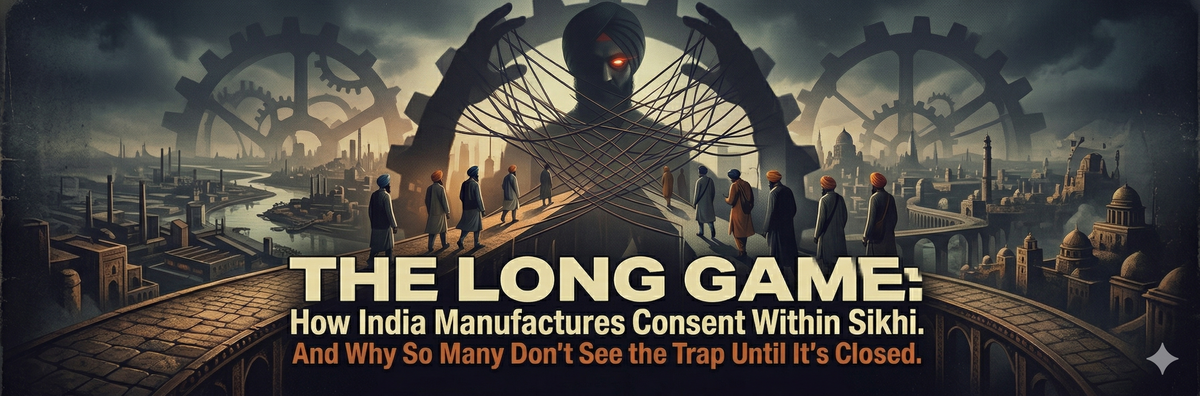
There is a particular kind of warfare that leaves no bullet casings. No tanks. No bodies in the street at least not immediately. It operates through culture, through money, through carefully placed voices, and through the slow erosion of memory. India has been waging this war against Sikhs for decades, and it is winning battles not through force alone, but through infiltration.
This is not conspiracy. This is documented statecraft. And the most devastating evidence is not in Panjab Police files or RAW operations manuals. It is playing on your speakers right now.
The Architecture of Manufactured Dissent
To understand how a state dismantles a religious and political identity from within, you need to understand what it is actually afraid of.
India fears Sikhi, not the sanitised, festival-version of Sikhi that fits neatly into the "unity in diversity" brochure but actual Sikhi. The Sikhi of Guru Nanak that declared the state corrupt and the priest a fraud. The Sikhi of Guru Gobind Singh that institutionalised armed resistance to tyranny. The Sikhi that produced the Akali movement, that dismantled the British-backed mahant system, that agitated for linguistic rights, that gave birth to demands for genuine sovereignty.
That Sikhi is a problem for any centralising state.
So the solution is not to ban it. Banning creates martyrs. The solution is to replace it gradually, almost imperceptibly with a version that looks like Sikhi, sounds like Sikhi, but has been hollowed out of everything that made it dangerous to power.
You do this by controlling the voices people trust.
The Playbook: Fake Sikhs, Real Power
The method is not new. It has been used against every minority identity that threatened the homogenising project of the Indian nation-state. But it has been applied to Sikhs with particular sophistication.
The formula works like this:
Step one: Identify the credibility structures. Who do Sikhs listen to? Granthis. Scholars. Musicians. Politicians. Community leaders. Gatekeepers of culture and narrative.
Step two: Infiltrate or manufacture them. Some are recruited. Some are created from scratch given platforms, funding, media access, government adjacency. They are built up slowly. They accumulate followers. They earn trust. They become the voice of the community in the eyes of outsiders and, eventually, in the eyes of the community itself.
Step three: Inject the ideology. Once the trust is established, the work begins. Not through crude propaganda that gets rejected. Through drift. Subtle reframings. Historical revisionism presented as scholarship. Cultural content that feels authentic but carries a payload. The slow normalisation of ideas that would have been immediately recognised as alien a generation earlier.
Step four: Wait. The genius of this operation is its patience. A generation raised on the drift doesn't know there was ever a different direction. By the time the damage is visible, it feels like it was always there.
The Caste Injection: The Most Successful Operation
If you want to see this playbook at its most effective, look at caste.
Sikhi's position on caste is not ambiguous. It is not a matter of interpretation or debate among serious scholars. Guru Nanak's first act of theological disruption was to reject the sacred thread the physical symbol of Brahminical caste hierarchy. The langar, instituted from the very beginning, was a radical equaliser, everyone sits at the same level, eats the same food. The Khalsa, established in 1699, was explicitly drawn from all castes the Panj Pyare were five men from five different backgrounds, a deliberate and public demolition of birth-based hierarchy.
Caste, in Gurbani, is not just discouraged. It is identified as maya illusion. A false consciousness that separates human beings from each other and from the divine.
This is not a minor point in Sikh theology. It is foundational.
So how, in 2026, are caste identities not only present within Sikh communities but celebrated? How are Panjabi musicians many of them from Sikh families dropping caste surnames as flex? How did "Jatt" become a brand, a swagger, a commercial product?
It did not happen accidentally.
Panjab in the 70s, 80s and 90s: The State's Most Patient Operation
The 1984 massacre and its aftermath dominate how we remember that period. And they should. But something else was happening simultaneously quieter, longer in execution, and arguably more lasting in its damage.
From the 1970s onwards, the Indian state used state benefits, land policy, and political patronage to selectively empower certain caste communities in Panjab in ways that were structured to produce fracture rather than solidarity. The Jat Sikh peasantry, already economically dominant through the Green Revolution, was cultivated as a distinct political bloc given enough to feel secure, pressured enough to feel threatened, and always positioned against other communities rather than against the state.
This is land reform and economic policy as a tool of social engineering. You don't need to send agents. You reshape the incentive structure, and the culture follows the money.
By the 1980s, as militancy rose and the state crackdown intensified, the cultural space was also being worked. The rich, pluralistic tradition of Panjabi folk music which had always carried Sufi influence, the voices of women, the poetry of longing and loss, the memory of Partition began to narrow. The space contracted around certain identities. Certain stories were amplified. Others were buried.
The cinema followed. Panjabi film, once capable of producing work with genuine social critique, drifted toward a increasingly limited set of narratives rural nostalgia, male bravado, and crucially, caste identity as romantic hero.
By the 1990s and into the 2000s, as the diaspora grew and the Panjabi music industry globalised, the content that travelled farthest was the content that had been most thoroughly shaped by this drift. The underground Dhol-driven stuff. The Jatt pride anthems. The content that packaged caste identity as culture and exported it to second-generation kids in Southall, Brampton, and Fresno kids who were looking for roots and were handed a counterfeit.
When the Counterfeit Becomes the Original
This is the cruelest part of the operation.
The children and grandchildren of those who migrated did not receive Sikhi whole. They received fragments the 5 Ks perhaps, Waheguru on the lips, langar on a Sunday alongside a cultural identity that had already been shaped by the injection. They did not know there had been a substitution because no one around them remembered the original clearly enough to describe it.
So when a young British-Panjabi man in Birmingham calls himself "Jatt to the core," he is not being provocative or irreligious in his own mind. He has been handed that identity as his heritage. He does not know he is carrying the product of a decades-long state operation to fracture the community that his own faith was built to unite.
And when someone does try to tell him that Sikhi explicitly rejects caste, that his Guru sat and ate with those his caste hierarchy would have considered untouchable, that the very identity he is celebrating would have been anathema to the men who died to protect him and his right to keep his hair it sounds to him like an attack on his culture.
The trap is complete when the prisoner guards the cell.
The Broader Pattern: Fake Scholarship, Captured Institutions
The caste injection is the most visible because it went mainstream. But the same operation runs through other channels.
There is a decades-long project to introduce pseudo-historical claims into the Sikh scholarly space. Claims that reframe Sikh history as a subset of Hindu history. That reposition Sikh Gurus as Hindu reformers rather than the founders of a distinct and sovereign spiritual tradition. That subtly blur the boundaries between the Khalsa and the RSS-adjacent "Hindu family" framing.
This comes with funding. With think tanks. With academics given platforms and publishing deals. With YouTube channels that look credible and build audiences before the payload is visible. With social media accounts that gain trust through legitimate Sikh content and then begin the drift.
The institutions themselves have been targeted. The SGPC the body that controls the historic Gurdwaras has been subject to sustained political pressure. The Akal Takht, the highest seat of Sikh temporal authority, has seen its independence eroded. When spiritual authority is captured, the community loses its immune system.
Why People Fall For It
Awareness of this problem requires some hard honesty about the community's own vulnerabilities.
The operation works because it exploits real things. Real pride in Panjabi culture. Real love of community and belonging. Real desire for roots among diaspora youth who grew up between two worlds. Real economic pressures that make political patronage appealing. Real exhaustion from constant struggle that makes the easier, louder, more commercially successful identity feel like a relief.
The counterfeit works because it gives you something. It just gives you something that serves someone else's agenda.
And the timeline of the operation is longer than the average attention span. The person who accepts the caste-pride framing in 2005 does not connect it to a policy decision made in 1978. Why would they? The chain is long, deliberately obscured, and the people at each link often had no idea they were links.
The Recovery
The good news and there is good news is that the very thing the operation is designed to destroy is also the thing that contains the antidote.
Gurbani is unambiguous. Return to it directly. Not through intermediaries who have been positioned to interpret it for you. Sit with Guru Granth Sahib Ji. Read the Nitnem. Understand what Guru Nanak actually said about caste, about ego, about the illusion of superiority. It is all there. It has always been there.
The Khalsa was designed, explicitly, to be resistant to exactly this kind of infiltration. "Raj Karega Khalsa" is not a triumphalist slogan. It is a declaration that the Khalsa governs itself that no external authority, no state, no purchased scholar, no manufactured voice has jurisdiction over what Sikhi is and what it means.
Every generation has to claim that back. The claiming starts with recognising the operation. With asking: where did this come from, who benefited from me believing it, and does it survive contact with Gurbani?
If the answer to that last question is no put it down. No matter how comfortable it feels. No matter how many people around you are carrying it. No matter how many views the song has.
The Gurus did not build this tradition to be comfortable. They built it to be free.
Hold that standard. Pass it on intact.
This article is written to provoke examination, not to provide final answers. The author encourages every reader to go directly to primary sources Gurbani, verified scholarship, and honest community dialogue and to be deeply suspicious of any voice, including this one, that has not earned your trust through demonstrated commitment to the truth.
Sources & Further Reading
- Surinder S. Jodhka (2004): "Sikhism and the Caste Question: Dalits and their Politics in Contemporary Punjab", Contributions to Indian Sociology, 38(1-2)
- Harjant S. Gill (2012): "Masculinity, Mobility and Transformation in Punjabi Cinema: From Putt Jattan De to Munde UK De", South Asian Popular Culture
- GBS Sidhu (2020): The Khalistan Conspiracy: A Former R&AW Officer Unravels The Path To 1984
- Mark Tully & Satish Jacob (1985): Amritsar: Mrs Gandhi's Last Battle
- Kuldip Nayar & Khushwant Singh: Tragedy of Punjab
- H. Telford (1992): "The Political Economy of Punjab: Creating Space for Sikh Militancy", Asian Survey, Vol. 32
- Economic and Political Weekly, multiple issues on Jatt masculinity and caste in Punjab
Reference Index: Jatt Caste Elevation & Sikh Fragmentation
A. Legislative Instruments
- Punjab Land Alienation Act (1900) Colonial law that formally designated Jatts as the sole "agriculturalist caste," stripping Khatris, Aroras, Ramgarhias and other Sikh communities of land ownership rights and legally fracturing the Panth along caste lines.
B. Primary Colonial Sources
- A.H. Bingley — Sikhs (1899) Original British military report explicitly recommending Arora Sikhs be excluded from military recruitment, documenting state-designed marginalisation of non-Jatt Sikhs from martial identity and prestige.
- British Martial Race Policy (1857–1914) Colonial military doctrine that selectively elevated Jatt Sikhs as "martial" while categorising other Sikh communities as unfit for service, manufacturing a hierarchy that had no basis in Sikh theology.
C. Foundational Academic Texts
- Surinder S. Jodhka "Sikhism and the Caste Question: Dalits and their Politics in Contemporary Punjab", Contributions to Indian Sociology, 38(1-2) (2004) — Definitive study showing Jatt dominance of Gurdwara governance, land and Sikh institutional life, directly contradicting Sikh egalitarian theology.
- Surinder S. Jodhka "Sikh Religion and Contentions around Caste", MDPI Religions (2024) Documents how Khatris the founding caste of Sikhi, from whom all ten Gurus came have been progressively marginalised within their own faith.
- P.S. Judge — "Changing Caste Relations and Emerging Contestations in Punjab", SAS-Space, University of London — Analyses the structural shifts in caste power in Punjab and the political contestations they produced across all Sikh communities.
- MDPI — "Deras, Identity, and Caste Cleavages in Sikh-Dominated Society of Punjab" (2024) Documents how post-independence Jatt economic and political dominance led to non-agriculturalist Sikh castes being explicitly labelled "Bhapas" second-class Sikhs.
- H. Telford "The Political Economy of Punjab: Creating Space for Sikh Militancy", Asian Survey, Vol. 32 (1992) Shows how Green Revolution benefits disproportionately consolidated Jatt economic and political power, deepening inter-Sikh caste inequality.
- Raj Kumar Hans — "Making Sense of Dalit Sikh History", Dalit Studies, Duke University Press (2016) Records Ambedkar's rejection of conversion to Sikhism after finding widespread caste discrimination in Sikh rural society, proving institutional capture had already occurred by mid-20th century.
D. Historical and Biographical Texts
- Khushwant Singh — A History of the Sikhs, Vol. 1 & 2 (1953/1966) — Foundational Sikh history documenting the shift of socio-religious leadership from Khatris to Jatts and the British role in constructing Jatt martial identity.
- Dr. Gokul Chand Narang — Transformation of Sikhism Early scholarly account of how colonial policy and land legislation began transforming Sikh social structure away from its egalitarian founding principles.
- Richard G. Fox — Lions of the Punjab: Culture in the Making (1985), University of California Press Argues the British actively manufactured a martial Jatt-Sikh identity for military utility, not as recognition of pre-existing reality.
- Heather Streets — Martial Races: The Military, Race and Masculinity in British Imperial Culture, 1857–1914(2004) Broader analysis of the racial ideology used to elevate specific Punjab castes over others across the colonial period.
- Nicola Mooney — "The Yeoman Jats of Punjab: Time, Expertise and the Colonial Construction of Jat Sikh Identity", Anthropologica, Vol. 55, No. 2 (2013) Demonstrates that the primordial Jatt identity now treated as ancient heritage was actively constructed by British colonial expertise.
E. Political Record
- Sant Fateh Singh to Parkash Singh Badal — Documented Political Succession From independence onwards, virtually every major Sikh political leader has been Jatt, with Giani Zail Singh (Ramgarhia) as the sole documented exception, confirming monopolisation of Sikh political power by one caste.
- Master Tara Singh — Last Major Khatri Political Figure in Sikh Leadership His marginalisation marks the effective end of Khatri political representation within Sikh leadership, despite Khatris being the founding community of the faith.
F. Cultural Analysis
- Punjab Portraits — "Jatt Dominance of Punjab Politics" (2020) Citing sociologist MN Srinivas, documents how Jatt cultural values machismo, honour culture, liquor, land became synonymous with all Punjabi culture, erasing Khatri, Arora, Ramgarhia and other Sikh identities.
- Harjant S. Gill — "Masculinity, Mobility and Transformation in Punjabi Cinema", South Asian Popular Culture (2012) Analyses how Punjabi cinema exported a specifically Jatt masculine identity as universal Punjabi identity, displacing the full breadth of Sikh cultural heritage.
- SikhNet — "The Struggle of Ramgarhias" (2024) Documents pre-1900 Ramgarhia land ownership and the systematic stripping of that through colonial legislation, and the community's subsequent erasure from the Sikh cultural and political narrative.
G. Theological Counter-Sources
- Guru Granth Sahib Ji — Ang 349, 1163 — Primary scriptural rejection of caste, Guru Nanak's direct condemnation of birth-based hierarchy as maya.
- The Panj Pyare (1699) — Documented caste backgrounds of the first five initiated Sikhs drawn from five different castes as Guru Gobind Singh's deliberate and public demolition of caste hierarchy.
- Sikh Rehat Maryada — SGPC Published Official Khalsa code making no distinction between Sikhs on the basis of caste, directly contradicting every caste-based practice documented in sources above.
Comments ()