
H. S. Phoolka: The Snake in the Dastar
Let’s be honest about what H. S. Phoolka is. Not a hero. Not a martyr-in-waiting. A career politician who built his entire brand on the blood and grief of 1984
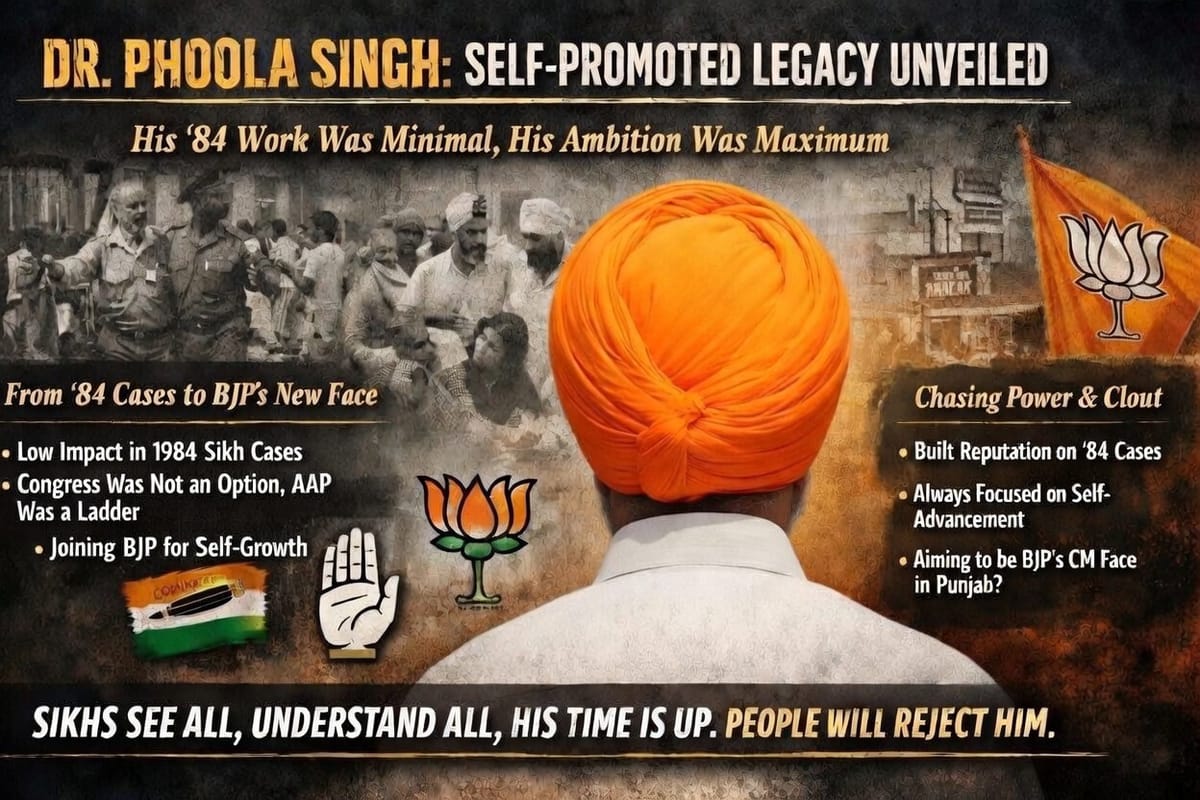
The Sikh community has a problem. We are too loyal, too trusting, and too slow to call out the men who wear our pain as a costume. Phoolka is a masterclass in that exploitation. It’s time to name it plainly.
The Brand Was Always the Point
When the massacres of October and November 1984 tore through Delhi leaving thousands of Sikhs dead and a community destroyed Phoolka was there. He stayed. He filed cases. He co-authored books. He became the face of 1984 justice.
And that face was worth a great deal.
Decades of litigation. Mountains of coverage. A narrative so well-crafted that questioning it felt almost sacrilegious. But ask the harder question, what actually changed?
A handful of convictions. Sajjan Kumar. A few others. Against a massacre of thousands. Against a list of perpetrators that ran deep into Congress’s organisational spine. After forty years of work, the overwhelming majority of those responsible remain free, untried, or dead of old age in comfortable homes.
That is not a verdict on the justice system alone. It is a verdict on whether Phoolka’s primary goal was ever justice or whether justice was the vehicle for something else entirely.
Why He Never Joined Akali Dal. Think About That.
Here is the question nobody asks loudly enough: if Phoolka genuinely represents Sikh interests, why did he never align with the Shiromani Akali Dal the party that, for all its faults, is rooted in Sikh political identity?
The answer is not complicated. Akali Dal comes with accountability to the Panth. It comes with scrutiny from people who know the history, know the players, and cannot be easily dazzled by a polished narrative. It comes with expectations of serving the community, not just leveraging it.
Akali Dal would have demanded he be something. Not just perform it.
The smaller Sikh-aligned parties the Akali factions, the emerging voices same story. He stayed away from all of them. Because joining any of them would have meant his political identity was anchored in Sikhi itself, and that would have made his next move impossible.
His entire political value to India’s mainstream parties depended on him being palatable a Sikh voice that didn’t actually threaten the establishment. A controlled opposition. A useful symbol.
You cannot be that if you’re formally embedded in the Sikh political ecosystem. So he kept his distance. Deliberately.
The AAP Chapter: Ambition Dressed as Purpose
In 2014, Phoolka joined the Aam Aadmi Party. He lost in Ludhiana.
In 2017, he won a Punjab Assembly seat, briefly became Leader of the Opposition, then resigned citing his need to return to 1984 legal work, since holding office restricted his practice.
It was framed as noble sacrifice. The man walking away from power for principle.
Except he didn’t walk away from politics. He walked away from that platform when it stopped serving him. There’s a difference.
His time in AAP gave him what he needed legislative credibility, national media column inches, and continued relevance as a political figure. When AAP’s Punjab fortunes collapsed and his position within the party reached its ceiling, the narrative of returning to legal work was the clean exit.
Phoolka has always known how to exit cleanly.
BJP. Let That Land.
In April 2026, Harvinder Singh Phoolka joined the Bharatiya Janata Party.
The BJP. The same political ecosystem that has spent decades stoking Hindu nationalist sentiment. The same political culture that has long viewed Sikh assertiveness with suspicion. The same establishment that has shown precisely zero appetite for the kind of structural accountability for 1984 that Phoolka claimed to have spent his career demanding.
His stated reason, Punjab’s development. Governance. Moving forward.
This is what the end of a narrative looks like when the man inside it no longer believes it himself.
AAP couldn’t give him what he wanted. Congress was never an option too toxic given his 1984 identity. The Sikh parties were never an option too accountable. So BJP it is. The one party with the infrastructure, the money, and the machine to give an ambitious man a platform regardless of what he’s actually stood for.
This is not a political pivot. This is a man cashing in whatever remained of his credibility before the market closes.
The Real Lesson for the Sikh Community
Phoolka is not unique. He is a type and the Sikh community will encounter this type again and again if we don’t learn to see it clearly.
The type looks like this:
They attach themselves to our deepest wounds. 1984. Khalistan. Discrimination. Persecution. They position themselves as the only ones fighting, the only ones who truly understand, the only ones with the courage to speak.
They build a personal brand on collective pain. The community’s tragedy becomes their political asset. Every interview, every book, every court appearance it feeds the narrative. And the narrative feeds them.
They avoid genuine accountability to the Panth. They don’t join the institutions that would hold them answerable to Sikhs. They stay just close enough to the community to harvest its trust, and just far enough away to operate without its oversight.
When the usefulness runs out, they move on. Not to retirement. To whoever offers the next platform. In Phoolka’s case the BJP.
What Sikhs Must Do
We need to sharpen our instincts. The measure of someone who claims to serve the Panth is not how often they invoke 1984, or how many cameras they stand in front of, or how many books they’ve written with our grief as the raw material.
The measure is, who do they answer to?
If the answer is not the community, if it is a political party, a media profile, or personal ambition dressed in Sikh language then we know what we’re looking at.
Phoolka spent decades being celebrated while delivering modest outcomes and building significant personal capital. Then he joined the BJP.
The Sikh community saw all of it. And now we must say clearly: we see it, we name it, and we will not repeat the mistake of confusing proximity to our pain with loyalty to our people.
Snakes don’t announce themselves. They show you their work slowly, over time, through who they serve when the moment of truth arrives.
There are people who will every now and then talk about Khalistan, Panjab & Sikhi just to be there enough but if they aren’t following it in principle then they are snakes.
This was Phoolka’s moment of truth.
Sources: Wikipedia biographical overview; Economic Times, April 2026 (BJP joining); Indian Express (1984 legal coverage); NDTV (AAP resignation); New Indian Express (Leader of Opposition resignation).
Comments ()